The ‘Braiding’ Of Western Scientific Knowledge With Indigenous Culture. My kind of synergyL
“I’m a glorified clam counter.”
So said Marco Hatch, a marine ecologist at Western Washington University and an enrolled member of the Samish Indian Nation. Hatch has been conducting surveys of mollusks growing in and around clam gardens in the Pacific north-west, as he collaborates with seven Indigenous communities to build or rebuild these rock-walled, terraced beaches once created and tended by their ancestors.
Hatch’s surveys in service of this reclamation are rooted in western scientific methodology and increase understanding about beach ecology and clam health. But, just as important, the data Hatch provides can help these nations obtain the local, state and federal permits they need to maintain or re-engineer these structures. And that helps them assert greater control over their heritage and regain food sovereignty for their communities.
Rather than dismissing Indigenous knowledge, more western scientists are discovering its viability for themselves and adjusting their research goals to embrace it.
That represents a “massive shift”, according to Kyle Whyte, a professor of environmental justice at the University of Michigan and a member of the Citizen Potawatomi Nation. Historically, western scientists have considered themselves rigorous and empirical, while they have classified traditional Native thought as mythic, religious or plain made-up, he said.
In fact, a long-overdue “braiding” of Native and western knowledge is becoming ever more common. Prominent Native authors such as Vine Deloria Jr have pointed out Native environmental practices in books for popular audiences. They’ve theorized, as the Alaskan native scholar Oscar Kawagley described it, “native ways of knowing”. More Indigenous people – Robin Wall Kimmerer, author of Braiding Sweetgrass, is a notable example – are entering academia and changing it from the inside, while some tribal nations have hired their own scientists.
Kisha Supernant, who is Métis and Papaschase and the director of the University of Alberta’s Institute of Prairie and Indigenous Archaeology, said that Indigenous knowledge contained “a rich history of observation, experimentation and understanding that has its own systems of rigor”. Such rigor is evident in places like the clam gardens that Hatch studies. Beginning at least 4,000 years ago, Native communities built clam gardens into the intertidal zone from Washington state through coastal British Columbia, and into south-east Alaska.
A lengthy read, but both essential and encouraging.
This Is A War Photo:

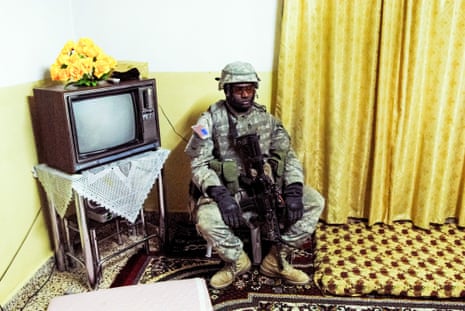
‘War is part of the human soul’ … Night Raid, Rawa, Iraq, 2006. Photograph: Peter van Agtmael/Magnum
“I took this picture during my first time in Iraq, 20 years ago. It was the first entry in a body of work about the US post-9/11, at home and at war, which has occupied a good chunk of my professional life for the last two decades. I had turned 25 the week before and it was a formative journey on a personal level. It was the first time I experienced war, and my understanding of my country and its relationship to the world developed in the crucible of this extremely violent situation, which was descending into civil war while I was there.
I had been embedded in Iraq with the US military for six weeks or so at this point, and had taken some good pictures. But this one was different and it still means something to me today. It was the first I had taken that wasn’t overtly channeling the history of war photography – which largely focuses on violence, horror and victims. Those are important things to show, but I wanted to understand this particular conflict, and how my position as an American of the same generation as those fighting could help me interpret it for the public. I guess the image crystallized something I had seen – this vast machine of military might mobilised in the Middle East; the momentum of all these young men with powerful weapons patrolling cities in search of people identified as enemies of America, enemies of democracy.
The soldiers would go into the homes of people they deemed suspicious, most of whom did not fit the definition of terrorist but some of whom did define as actively resisting occupation. The soldiers would search the houses of these “suspected terrorists”, and usually they found nothing.
With all this money, weaponry and rhetoric, an anonymous living room like this one, that could be my grandma’s, showed the reality of what I saw on the ground. A dejected soldier sitting in this domestic space.
To me, it’s a picture of that particular conflict, but it says something more enduring about the nature of war. The incongruity of the soldier in the domestic surroundings shows how absurd, and how close to us, war is. Insane violence continues amid absolutely normal life. I think it expresses that war is part of the human soul – in civilised society we tend to forget that. It’s disconcerting, but it reminds me that we’re animalistic.
History has shown that there’s a very, very narrow pathway to externally created regime change. When I was in Iraq, the war had already started spiralling out of control. Iraq and Afghanistan were both unmitigated failures, on every level. It’s very hard to be optimistic now.”
Some Call It–‘Dog-Wop’. They can even ‘auto-tune’:
If your dog, or one you’ve seen in a viral video, howls along to music or another dog’s howls like it’s trying to sing a song, it’s not just making some random noise in response to external stimuli. That dog might actually be trying to match the sound’s pitch.
A small study (one dog, perhaps?) published in Current Biology suggests that some domestic dogs can adjust the pitch of their howls to match sounds they hear, a behavior that has been previously observed in wolves. Researchers wanted to test the ability of fine-tuning vocal pitch during group howling to see whether this trait is a lingering remnant that survived domestication or if it faded away along with some other wild traits on the wolves’ path to becoming our sweet, lovable doggy companions.
Certain dog breeds are considered ancient, like Samoyeds and Shiba Inus, because their genetic lineage is a lot closer to wolves than most other dog breeds. The researchers recruited owners of some of these dogs and played them some of the usual sounds dogs howl at, like songs and emergency vehicle sirens. They then altered those recordings just a bit by shifting the pitch up or down. Then they sat back and just waited for the dogs to respond, if they responded at all.
There wasn’t a single, uniform discovery, but a small, noticeable pattern arose. Three of the four Samoyeds involved adjusted the pitch of their howls to better match songs like “Believer” by Imagine Dragons and “Shallow” by Lady Gaga and Bradley Cooper from the soundtrack of A Star Is Born. From that phrasing, you’d think the fourth dog did nothing, but actually did something a bit fascinating: it modified the pitch but then also modified the tonal quality of the sound, aka its spectral centroid. The Shiba Inus are less musically inclined. They didn’t change pitch, but one of them did alter the spectral centroid.
The ability to pitch shift is something most humans can do naturally. And it’s only been about 100 years since we figured out how to do it technologically, and soon, applying it to music post-production processing. Nowadays, you might better know it as one of the most popular (and arguably overused) pieces of audio processing software in the music industry: auto-tune, the thing that makes good singers sound great and bad singers sound like robots.
Ho-kay. In this AI Age, I have no idea if this story is true. I’ll just have to discuss this with my ChatBot, who is the most real person I know.
This voice was all-too human. One of the most expressive and empathic voices I’ve ever heard in rock. XPN devoted an entire hour to him on Friday b/c he’s been dead for 40 years. Today, we close out with THREE songs from Richard Manuel–one he wrote and sang lead on from ‘Music From Big Pink’, another from ‘Big Pink’ that he co-wrote with Bob Dylan (he wrote the music, Bob the lyrics) and perhaps my favorite vocal of his from a song on ‘The Band’ their second album:


