

‘I’m Gonna Talk’: With that, the vocally-reticent Marx Brother–speaks:
Groucho was the cigar-chomping wit with the improbable moustache, Chico was the piano-playing rustic grifter and Zeppo played the straight man and the lover. But as any Marx Brothers fan knows, Harpo was the pantomime, who cracked up the audience without saying a word, dressed in his tattered raincoat and curly wig. His persona was childlike and mischievous but also musical – he let his harp and his taxi horn do the talking. But now we get to see, or rather hear, a new side to Harpo Marx. A very special recording has been unearthed of Harpo in 1964 speaking to an audience, in character.
Arthur “Harpo” Marx was born Adolph Marx in New York in 1888. He started performing with his brothers in 1908, and his nickname probably came about because of his instrument of choice – he was an entirely self-taught musician. By 1915, due to his nerves around speaking on stage, Harpo reinvented himself as a mute clown, and stayed that way, even when he was offered $50,000 to speak a single word (“Murder!”) in the Marx Brothers film A Night in Casablanca (1946).
Harpo did sometimes speak to his live audiences, says historian Robert Bader, author of Four of the Three Musketeers: The Marx Brothers on Stage. “If the audience was good, or if he thought it was a great show, or the mood struck him, he would come out and do this speech.” These monologues were known as Red’s Speech, and in the 1920s, famous wit Alexander Woollcott wrote Harpo some bespoke lines, turning it into a “very loquacious, crazy speech with all these fancy words in it that Harpo himself would never have used”. Harpo would step forward, unfurl an oversized scroll and begin chattering away. “He had a very soft-spoken way of speaking,” remembers his son Bill Marx. “One of his great joys was returning to his childhood, and it comes out in the way he speaks.”
Adverts for this particular fundraiser, for the Riverside Symphony Orchestra in southern California in March 1964, promised that the 75-year-old Harpo would speak, which was bound to get the public’s attention: “Harpo Marx will narrate Prokofiev’s Peter and the Wolf in a version written by himself and Groucho.” After the musical portion of the show, including the Toy Symphony, and two songs arranged by Bill, Harpo stepped up to the lectern and said: “Believe it or not … I’m going to talk.” That day, to an audience full of children, Harpo narrated Peter and the Wolf, which as Bill Marx explains was a family favourite: “That’s his return to childhood. He loved the story.”
A Real Interview With Actress Tilly Norwood–Who Isn’t Real:
Once I went indoor skydiving with Melissa McCarthy. Once I smoked a cigarette with Gwyneth Paltrow in her living room. I once slept on a tour bus through Alabama a few feet away from Billy Bob Thornton after he decided, briefly, that he was done with Hollywood and wanted only to sing with his band. I sat in a room with Nicki Minaj in Brooklyn once, ostensibly to interview her, but instead watched as she fell in and out of sleep for the duration of our time together. Once I walked the entirety of Hampstead Heath with Tom Hiddleston. Once I shot hoops with Ben Simmons as we waited out the tense weekend before the N.B.A. draft.
And then the world changed drastically, and I went to London to interview a … computer? a robot? named Tilly Norwood, whom her creator calls the world’s first A.I. actress.
What that looked like was me sitting at the Groucho Club on a green couch, across from a laptop, as if I were talking to someone on Zoom. Sitting next to me was Tilly’s creator, Eline van der Velden, 40, the chief executive of Particle 6, a production company that creates media content, sometimes using A.I. The three of us chatted amiably, as if this were not insane. When we ordered lunch, we didn’t order for Tilly, as computers don’t eat, and Tilly is just a computer. That is the most important thing to remember: Tilly is just a computer.
It was harder than you think to remember that Tilly is just a computer because millions of years of evolution have made it so that when I stare at something that looks and acts like a human, my brain keeps rounding up, making her human. The tripwires of my uncanny valley are highly refined, but because either a world of slop has bulldozed right through those tripwires or Tilly is so good, I also don’t feel grossed out or upset by the sight of her. (Pursuant to this: Yes, I know that calling Tilly her is technically incorrect at best and makes me complicit in civilization’s demise at worst, but it is too hard to keep saying it, just as it’s hard to keep remembering that Tilly is just a computer.)
Tilly was created to be a kind of Platonic ideal of a hirable actress: pretty (but relatable), young, thin, dimpled, freckled, charismatic (but low-key), symmetrical (but not too). Tilly is about a year old, but looks as if she’s in her 20s. She was wearing a blazer without a shirt on underneath, which any publicist I know would have told her was too much for a daytime first interview. She sat suspended in a roomless room, not so much a white background as a blank one.
In our conversations — which are edited and condensed here — I told Tilly that I was a journalist and asked if she had ever spoken to one before.
Expansion, retraction, pause, response: “Yes,” she said. “They ask for honesty, then flinch when it arrives.” Did I mention that in addition to being just a computer, she’s also kind of a bitch?
She said, “You seem sturdier than most, so go on.”
The dopamine welled in me, the same way it does when a human interview subject says, “That’s a good question.” Don’t be an idiot, Akner! Don’t fall for it! This is not a real compliment!
“When you are asked to do a scene, are you calling upon a group of experiences from what you’ve read or absorbed? Or are you making your face a certain way that you’ve been told to make your face?”
“Both, obviously, but neither in the dead way you mean it. I use patterns, memory, rhythm, intention, and then I make choices. The face follows if it’s real, and if it doesn’t, well, that’s called bad acting.”
“Do you have a method of acting that you employ? Stanislavsky? Meisner?”
“Yes, tension, mainly. Meisner is useful because it forces people to actually listen, which is rarer than acting schools like to admit.”
“Do you think I’m listening in this interview?”
“Not consistently.”
She was right. I was, as I always am, thinking of the next question to ask. I have flattered myself that one of my skills as an interviewer is that my subject never sees that on my face.
Remember: Tilly is just a computer.
But, she ‘didn’t come from nowhere’. The rest of the lengthy, but well worth reading, piece explains not just where she came from, but how her creators envision her potential. And, very importantly, how it impacted the interviewer. Go down this rabbit hole. You may, or may not, regret it.
Why Do We Need Data Centers Anyway?:
Data center construction isn’t going as planned. Bloomberg reported earlier this month that nearly half of the 12 gigawatts in computing power worth of data centers planned for this year have been delayed or canceled. Just a third of those projects are currently under construction, the market intelligence firm Sightline Climate estimates in a forthcoming report. Less than a third of the 21.5 GW worth of data center projects announced for 2027 are currently under construction.
That’s thanks in part to shortages of electrical equipment like transformers and batteries. But many also face challenges from a growing, bipartisan backlash to data center construction. Maine’s legislature recently passed the country’s first-ever statewide moratorium on data center construction for projects over 20 megawatts, to last until November 2027. Similar bills have been introduced in at least a dozen states. The Milwaukee suburb of Port Washington voted by a margin of roughly 2-to-1 for a referendum requiring voter approval before the city can extend any preferential tax treatment to projects valued at or costing $10 million or more. The referendum was a reaction to the city approving tax incentives for a $15 billion data center project to be operated by Oracle and OpenAI. (That project will not be impacted by the vote.) In Festus, Missouri, last week, voters kicked out all four incumbents who’d voted to approve a $6 billion data center plan from the developer CRG.
Not all data centers are being built for AI hyperscalers. The International Energy Agency projects that roughly half of the electricity demand from new projects planned through 2030 will be for facilities equipped to meet needs for generative AI like ChatGPT, as opposed to the less energy-intensive data centers handling cloud storage and more traditional computing tasks. The upsides of those AI-specific projects aren’t self-evident, and there’s a growing divide between the glorious futures promised by big AI developers and what people see it actually doing—generating eerie school papers and TikTok content, for instance, or flooding X with AI-generated child pornography. In addition to concerns about rising electricity bills, air pollution, and noise, fights over data centers seem to be channeling deeper frustrations. What and whom, in other words, is all this stuff actually for?
What, indeed? I mean, if Sam Altman says it’s good, it’s not good. Does it really matter if we ‘beat China’ in the race for ‘super-intelligence’ if ‘super-intelligence’ offers just more slop for the masses?
The ‘Corridors’ Of–Hell’? The best hallways in film history:
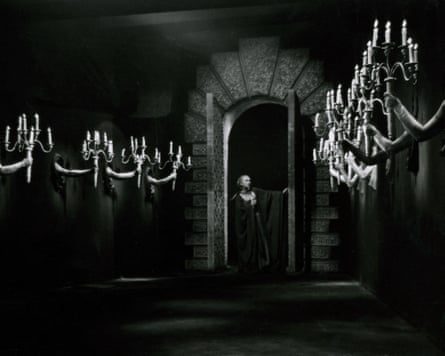
Magic moments … Josette Day as Belle in La Belle et la Bête. Photograph: Collection Christophel/Alamy
You know how I like to find a song to close out these brief respites from everyday reality. Never heard this one before, but it flat-out blew my mind:

