Late Night Music Video — Mashup via Rubik Cubes

The Beatles and the Clash! [dailymotion]http://www.dailymotion.com/video/x9ek87_top-10_creation[/dailymotion] h/t Andrew Sullivan

Friday, Geezer asked a very good question that I didn’t have time to get to in the Frank Luntz thread. His question: Why should we be for a non-single-payer “reform” plan?
Before I get to that and ask you guys to weigh in, I want to put up some resources to look at and to think about. These are mostly comparisons of health care systems from industrial countries (and none will take much time to review):
I include all of this (and these are worthy descriptions and comparisons — no system is perfect and I remind everyone that anecdotes are not data) to broaden abit the scope of the conversation.
Part of the problem in listening to either advocates or critics of single-payer is figuring out what they are talking about. Are we talking about recreating the entire system as single payer or just the portions that will cover the uninsured or underinsured? Does that leave for profit insurance companies in place or does if make all of them move to not-for-profit status? Critics of single payer frequently invoke the UK system as the single payer that advocates want, while spinning out their scary tales of the day. Advocates almost never make clear the scope of their thinking — especially (as you can see from the resources above) single payer can take multiple forms.
The Public Option that was proposed by the House on Friday is essentially a Medicare for All program. It would be paid for by premiums from its users, with the government subsidizing premiums for poorer people and families. This part of the proposal is basically single payer, paid for by premiums. It will offer insurance to those who don’t have it now and will provide a competitive choice for the rest of us.
Everyone who has paid attention to politics since Bill Clinton knows the name of Frank Luntz. He is a GOP pollster whose specialty is messaging. As in finding the words that either make it easier for people to emotionally engage on a position. Key to this effort is that truth or accuracy or anything near it is not crucial. Nor is it crucial to use language to educate people about the terms of the debate. Putting up slogans — often misleading as to their actual position is the game.
Yesterday morning I had one of those rare chances to listen to Al Mascitti for abit in my office. And who calls in? Mr. Shallow Bench who is telling Al that Luntz has done some amazing polling on what a health care plan needs to look like. This amazes me, because Luntz doesn’t do this kind of polling, so I went back to look at the Luntz findings, and it is still not a real poll on what people want or even their attitudes on an issue. These polls are designed to produce honest-to-god Talking Points. So take a good look at the Talking Points you’ll be hearing ad-infinitum from repubs for the next few months (and have been hearing already):
(1) Humanize your approach. Abandon and exile ALL references to the “healthcare system.” From now on, healthcare is about people. Before you speak, think of the three components of tone that matter most: Individualize. Personalize. Humanize.
(2) Acknowledge the “crisis” or suffer the consequences. If you say there is no healthcare crisis, you give your listener permission to ignore everything else you say. It is a credibility killer for most Americans. A better approach is to define the crisis in your terms. “If you’re one of the millions who can’t afford healthcare, it is a crisis.” Better yet, “If some bureaucrat puts himself between you and your doctor, denying you exactly what you need, that’s a crisis.” And the best: “If you have to wait weeks for tests and months for treatment, that’s a healthcare crisis.”
Health care rationing that is.
David Leonhardt at the NYT has another Must Read article detailing all of the ways that health care is rationed in the US.
Today, I want to try to explain why the case against rationing isn’t really a substantive argument. It’s a clever set of buzzwords that tries to hide the fact that societies must make choices.
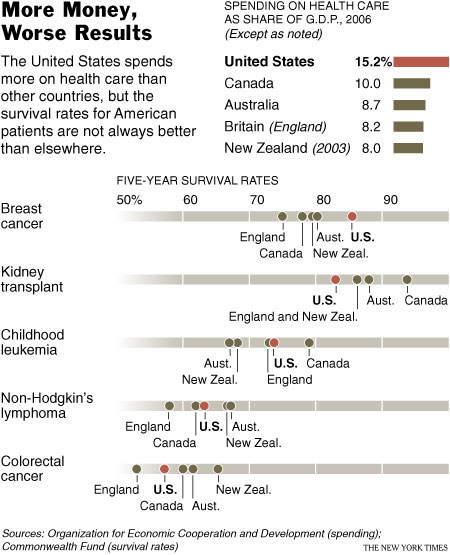
He spends his article taking a look at how rationing is something of an economic fact of life (there aren’t many of us driving one of these) — the allocation of scare resources requires active management, actually making decisions about how those recourses are allocated. Except as far as our medical care is concerned, we don’t actively think about allocating medical resources. So there is a built in passivity (or avoidance behavior of the decisions) that is ratcheting up the cost of our care and ensuring that our outcomes are collectively in the middle of the pack. To that end, they’ve included a very cool graphic: