Reverend Kilroy Delivers A Sunday Sermon

Reverend Kilroy Delivers A Sunday Sermon

Last week my phone started ringing and emails/texts poured in. Almost everyone began with: "Have you heard?" Why no, no I hadn't heard. Today Kilroy puts up a post addressing what's going on. Go read the post.
Those who sit at the right and left hand of the Red Clay God (Merv) better take a hard look in the mirror. Though school superintendents make many request for school board approval it is the school board who makes the final approval with no veto power on the super’s part. In the big picture the super’s failures are the board’s failures. [...] I am dishearten to hear (rumor of course) some board members want to throw Merv overboard midstream (before the end of his contract). Those who think Merv may be the problem are just as much the problem.
Yes Red Clay.  No Christina.   So What’s Next?

Yes Red Clay. No Christina. So What’s Next?

Residents in the Red Clay School District approved a measure that would raise taxes .35 cents per $100 of assessed property value over three years to cover increased operating expenses in their budget and provide for improvements in technology, curriculum and student services (the actual cost to the average homeowner in Red Clay once the measure is fully phased in would be $280 per year). Residents in the Christina School District had two options to chose from, and they said no to both. The first option was a bare bones measure to just "keep the lights on," and it would have raised taxes .65 cents per $100 of assessed property value phased in over three years. Only 26% of Christina residents voted yes to that. The second option would have raised taxes an additional .40 cents per $100 of assessed property value phased in over four years (so a total of $1.05 per $100), with the additional funds to pay for improvements in technology, arts, and early childhood learning. Only 22% voted yes. So what's next?
Markell’s Supreme Court, and a Missed Opportunity.

Markell’s Supreme Court, and a Missed Opportunity.

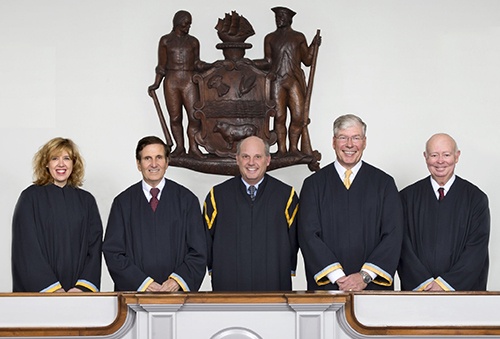
Nothing explains the Delaware Way more than the recent nomination to the Supreme Court by Gov. Jack Markell (D) of corporate attorney and the son of a former Supreme Court Justice, Collins J. “C.J.” Seitz, Jr., Esquire. Seitz, when confirmed (because there is no if about it in this state), will replace retiring Justice Henry duPont Ridgely. The Judicial Nominating Commission, in addition to Seitz, also recommended to Governor Markell Superior Court Judge Calvin Scott, who would have been the first African American Supreme Court Justice on the Delaware Supreme Court; and a former Superior Court judge and now an attorney in private practice, Joseph Sleights III. I think the Delaware Supreme Court could have used a little color, and something more diverse than another corporate attorney.
Lavelle Will Not Run for Governor in 2016

Lavelle Will Not Run for Governor in 2016

Breaking news from Jonathan Starkey at the News Journal:
Republican Sen. Greg Lavelle will not seek the governor's office next year, according to a letter the lawmaker sent to political supporters. [...] Lavelle told supporters this week he "had given a lot of thought" to a run for governor, but said personal commitments prevented him from launching a campaign. "I have decided that now is not the time for me to take on this challenge," Lavelle wrote. "At this time, the personal bandwidth just doesn't exist to create and sustain the time needed to run for Governor, while maintaining and addressing my current and varied responsibilities."
Saturday Open Thread [2.21.15]

Saturday Open Thread [2.21.15]

Jake Miller at CBS examines how Common Core may become a primary issue for Republican presidential candidates. Eventually, I think it will become an issue in Democratic politics as well. If Kavips has his way, it already has:
Common Core federal education standards are riling the conservative base, and as the 2016 Republican presidential field takes shape, the standards -- seen by right wing activists as a federal overreach and a threat to parental rights -- are poised to play a big role in the GOP nominating process. That's doubly true in Iowa, where the kinds of Republican voters most vehemently opposed to Common Core -- evangelical Christians, home-schooling advocates, states-rights conservatives -- exert considerable influence over the state's first-in-the-nation presidential caucus.