
Open Thread for Thursday, October 6, 2016

Open Thread for Thursday, October 6, 2016

The Atlantic, for only the third time since their founding in the 1850's, have endorsed a candidate: Hillary Clinton, who joins the ranks of Abraham Lincoln and Lyndon Johnson.
Today, our position is similar to the one in which The Atlantic’s editors found themselves in 1964. We are impressed by many of the qualities of the Democratic Party’s nominee for president, even as we are exasperated by others, but we are mainly concerned with the Republican Party’s nominee, Donald J. Trump, who might be the most ostentatiously unqualified major-party candidate in the 227-year history of the American presidency… Our interest here is not to advance the prospects of the Democratic Party, nor to damage those of the Republican Party. If Hillary Clinton were facing Mitt Romney, or John McCain, or George W. Bush, or, for that matter, any of the leading candidates Trump vanquished in the Republican primaries, we would not have contemplated making this endorsement. We believe in American democracy, in which individuals from various parties of different ideological stripes can advance their ideas and compete for the affection of voters. But Trump is not a man of ideas. He is a demagogue, a xenophobe, a sexist, a know-nothing, and a liar. He is spectacularly unfit for office, and voters—the statesmen and thinkers of the ballot box—should act in defense of American democracy and elect his opponent.
Open Thread for Wednesday, October 5, 2016

Open Thread for Wednesday, October 5, 2016

Taegan Goddard:
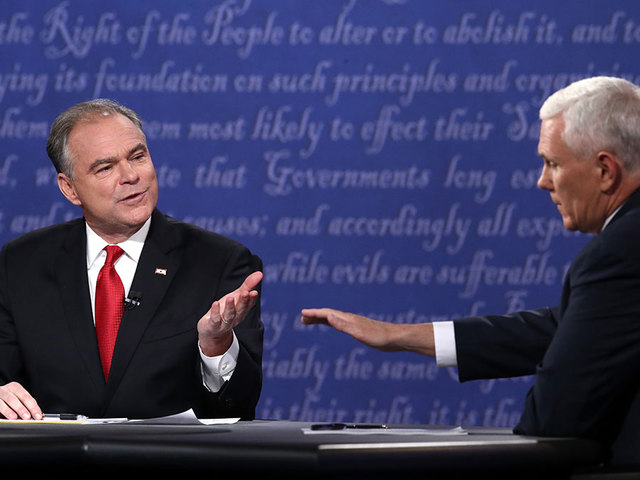
Pence had a much tougher job at the outset. After Donald Trump’s disastrous debate performance last week, Pence needed to do something to reverse the momentum. He didn’t do it. Aside from brushing aside what Trump has said, it’s not clear what his strategy was. On some issues, like Russia and Syria, Pence actually disagreed with Trump. All Kaine needed to do was make the debate about Donald Trump but he couldn’t do it either. He came off as nervous and overly rehearsed. He didn’t effectively call out Pence for denying basic facts about Trump. If you scored the debate on style, Pence probably won narrowly. He looked into the camera and came off as the calmer of the two. I suspect most instant polls will find Pence the winner. However, Kaine was a much better running mate. He defended the nominee at the top of his ticket. Pence wasn’t willing to do it. After watching the debate, it’s clear that Kaine is running for vice president in 2016. But Pence sounded more like he’s running for president in 2020.
Open Thread for Tuesday, October 4, 2016

Open Thread for Tuesday, October 4, 2016

Here’s Alexander Burns on tonight’s debate:
Mr. Pence can expect to be challenged on Mr. Trump’s denigrating comments about Alicia Machado, a former Miss Universe; on Mr. Trump’s attacks on Mrs. Clinton’s marriage; and on the prospect that Mr. Trump may have gone nearly two decades without paying federal income taxes. And those are just the hits from last week. Up to this point, Mr. Pence has proved adept at deflecting questions about Mr. Trump’s incendiary comments, redirecting interviews to rote talking points about shaking up Washington. But a debate is an entirely different format; and as Senator Marco Rubio of Florida found, using the same dodge over and over again can have catastrophic consequences.
Open Thread for Monday, October 3, 2016

Open Thread for Monday, October 3, 2016

Josh Marshall thinks there is more, much more on the horizon with Donald and his taxes (or lack thereof).
After thinking over the Times revelation, I wonder whether there's a much, much bigger story here that the Times didn't put together or more likely did see but couldn't prove. In any case, here's what I'm thinking. We've known for years that the collapse of Trump's debt ridden casino empire in Atlantic City almost destroyed him more than two decades ago. He was able to wriggle through by a number of angles and connivances. But one of the biggest was that he was able to convince his lenders that they'd be even worse off if he was cleaned out and removed from the picture entirely. Convincing them that he was in essence too big or too important to fail, they took major 'haircuts' (losses) that allowed him to survive. He got others to absorb the impact of the losses, repackaged other parts and put them through bankruptcy, etc. The key question is how much of the Atlantic City losses did Trump absorb in real terms? How much of those losses were forgiven or written off formally? And perhaps most importantly, how much of those losses were squirreled away or 'parked' in places which effectively put them in a sort of limbo or suspended animation - neither truly absorbed nor forgiven? Here's where the Times revelation comes into play. If you sustain real capital losses, you can apply those losses to cancel out future income/profits and reduce your tax liability. But if your losses are canceled out by debt forgiveness, the debt forgiveness is counted as income. That cancels out the losses that would provide you with the tax benefit. In other words, you can't have your cake and eat it too.
At the end of this campaign, more likely than not, Donald Trump will be arrested for tax evasion on hundreds of millions of dollars of income. And then he will be locked up.
Open Thread for Sunday, October 2, 2016

Open Thread for Sunday, October 2, 2016

Donald Trump “declared a $916 million loss on his 1995 income tax returns, a tax deduction so substantial it could have allowed him to legally avoid paying any federal income taxes for up to 18 years,” records obtained by the New York Times show. “The 1995 tax records, never before disclosed, reveal the extraordinary tax benefits that Mr. Trump, the Republican presidential nominee, derived from the financial wreckage he left behind in the early 1990s through mismanagement of three Atlantic City casinos, his ill-fated foray into the airline business and his ill-timed purchase of the Plaza Hotel in Manhattan.” “Tax experts hired by The Times to analyze Mr. Trump’s 1995 records said that tax rules especially advantageous to wealthy filers would have allowed Mr. Trump to use his $916 million loss to cancel out an equivalent amount of taxable income over an 18-year period.”