Wednesday Open Thread [3.30.16]

Wednesday Open Thread [3.30.16]

Jonah Goldberg: “If Trump misses the mark by, say, 150 delegates, that would be significantly more than the delegate totals of Iowa, New Hampshire, and South Carolina combined. It’s one thing to deny the trophy to the guy who finished a few yards shy of the finish line. It’s another if he misses it by a mile. The bigger the shortfall, the easier it is to persuade delegates that they are not defying the popular will by denying Trump, particularly given the widespread conviction that Trump would be crushed in a general election (with the GOP being torn apart in the process).” “Cruz would be the most likely victor in a floor fight, but that isn’t assured. The longer the balloting goes, the more likely it is that the bitter and bleary-eyed delegates will opt to order off-menu. That’s what Kasich is allegedly counting on. But Kasich is widely disliked, and it might be a good deal easier to find a unifying candidacy in, say, Rick Perry, Scott Walker, Nikki Haley, or Mike Pence.”

Which candidate was a client of the DC Madam?

A lawyer who represented the so-called “D.C. madam” says he has phone records that could influence the outcome of the presidential election, and he’s threatening to release one or more names on the steps of the U.S. Supreme Court if he’s denied a hearing on his right to distribute them.
So let's assume Montgomery Blair Sibley, the late "DC Madam" Deborah Palfrey’s attorney, does have information that ties one of the current candidates to some of the same prostitutes famously frequented by former Senator and presently disgraced pious blow-hard, David Vitter... which one is it? I have listed the candidates from LEAST likely to MOST likely:
Who said it, Hans Reigle or John Carney?

Who said it, Hans Reigle or John Carney?

Take the quiz. Identify which statement was copied from which candidates web page, and I'll post the correct answers in the comment section this afternoon. Deficit: A: "For too long, Democrats and Republicans have spent trillions of dollars the nation didn't have." B: "Eliminate wasteful spending that is draining our nation's economic resources. An $19 trillion national debt is unacceptable." Jobs: A: "Reclaim high tech and low tech manufacturing jobs to enable more Americans to work. Too many jobs have moved overseas. Strong export industries like aerospace and agriculture need to be nurtured." B: "Delawareans are not just competing against other Americans for good jobs -- they are competing against an increasingly educated workforce around the world. By investing in innovation and building the industries of the future, the U.S. will continue to grow and maintain the world's leading economy." Education: A: "...states and school districts should have flexibility in determining how best to educate their students." B: "Local control of education needs to be increased and maintained." National Security: A: "Address our border control problems in order for Americans to reclaim our sense of security. Current immigration laws are not being properly enforced. A weak border complicates immigration reform and is a threat to our national security. Unvetted immigrants should not be allowed entry into the United States. B: I firmly believe that America should be focused on nation-building here at home, not abroad, I feel strongly that we must maintain a counterterrorism infrastructure that ensures a tragedy like September 11th will never happen again.
Tuesday Open Thread [3.29.16]

Tuesday Open Thread [3.29.16]

David Plouffe:
Ok, you say. We get that Clinton has built a strong delegate lead. But she should be able to close this out with more strength, winning the vast majority of the remaining states. And if she doesn’t, it shows weakness for the general election. Well, [...] [a]t this time eight years ago, ]President Obama] too had an all but insurmountable delegate lead. But in the last 9 contests, we lost 6 of them. Now, we had some issues like Rev Wright we were fighting thru. And Hillary Clinton campaigned admirably. But we predicted those losses long before based on the results we were seeing in the earlier primaries and caucuses. Even as we were moving towards the nomination, and ultimately the Presidency, we knew we would lose a bunch of states in the latter part of the primary calendar. Some suggested it showed weakness or would hurt us in the general. History suggests otherwise.
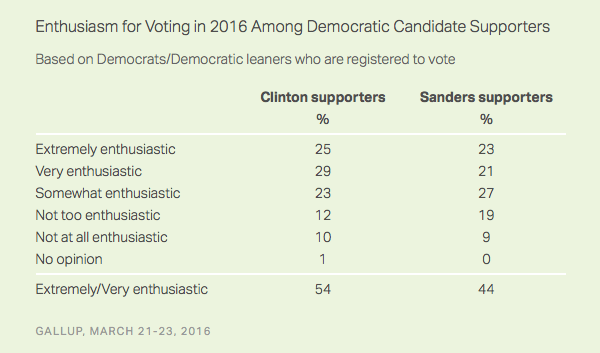
Bernie had an expected good weekend, and some fools decided that it meant he was absolutely going to be the nominee, despite the math, despite the upcoming slate of primaries that all favor Hillary by large margins, despite the history that Plouffe so expertly lays out. Boy, some of you are going to have to eat a lot of crow in May. Do you like Ketchup to go with it?
Monday Open Thread [3.28.16]

Monday Open Thread [3.28.16]

Harry Enten says Sanders overperforms in Caucauses, and he doesn't gain momentum from his caucus wins, and he is about to run out of caucuses to win.
The problem for the Sanders campaign is that there are only two caucuses left on the Democratic primary calendar. [...] Now, I know what some of you are thinking: How do we know that Sanders’s big wins this week aren’t a sign that something more fundamental about the Democratic race has changed? We don’t, necessarily. But look at the calendar: Sanders also outperformed his delegate targets in Colorado, Kansas and Maine earlier this month, and he still went on to suffer big losses on March 15. And that was after his shocking Michigan victory. Moreover, Sanders greatly underperformed his delegate targets last Tuesday in Arizona, which held a primary and has a more diverse electorate. Most likely, Sanders will need to find another way to make up ground on Clinton in the delegate race. Wyoming (April 9) and North Dakota (June 7) are the only remaining stateside caucuses. The rest of the stateside races are primaries. Sanders has exceeded his delegate targets in just three stateside primaries. He’s matched them in three and underperformed in 15. Given that Sanders is still so far behind in the delegate count, he needs to outperform his delegate targets by a lot. How likely is that? Well, he’s behind by about 6 percentage points in Wisconsin, according to FiveThirtyEight’s weighted polling average. That’s not a huge deficit, and it wouldn’t shock me if Sanders won Wisconsin given that the black population there is below 10 percent. (To match his delegate target in Wisconsin, he needs a net gain of 10 delegates there.) Sanders, though, will likely have more difficulty in later primaries in April, such as Connecticut, Delaware, Maryland, New York and Pennsylvania, where African Americans make up more than 10 percent of the state’s population. Sanders had a strong week, and this has been a crazy year in politics. But there’s nothing in the recent results to suggest that the overall trajectory of the Democratic race has changed. Clinton was and is a prohibitive favorite to win the nomination.

Easter Sunday Open Thread [3.27.16]

As expected, Bernie Sanders won blowout wins in Washington, Hawaii and Alaska. It keeps him going, although it does little to change the structure of the race. To do that, he is going to have to win New York by blowout margins. He narrowed the delegate yesterday by winning 104 delegates to her 38, earning him a net gain of 66 delegates. So now Clinton's delegate lead is down to 250. To win the nomination, Bernie will need to win all the remaining states by margins he enjoyed yesterday, 73 to 25. And there are only two more caucus states remaining where he can do that (Wyoming and North Dakota).