Tag Archives: feminism

A Woman’s Place Is In The House (of Representatives)

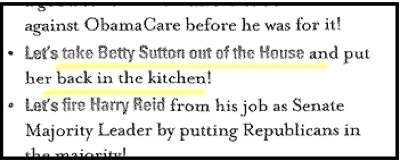
This is from an actual newsletter sent from the Republican party in Ohio. It’s referencing the OH-13 House race, where the incumbent is Betty Sutton.

I know I keep seeing polls that show Democrats are in trouble in November. Sometimes, though, I have a hard time taking it seriously – specific Republicans are a lot more insane than the generic Republican.

John Derbyshire Takes A Brave Stand Against Women’s Suffrage

National Review’s John Derbyshire has a book coming out soon called We Are Doomed: Reclaiming Conservative Pessimism. In the book Derbyshire makes an argument for repealing women’s voting rights in a section called “The Case Against Female Suffrage.” Derbyshire was interviewed by Alan Colmes and Colmes pressed him about this section of the book:

DERBYSHIRE: Among the hopes that I do not realistically nurse is the hope that female suffrage will be repealed. But I’ll say this – if it were to be, I wouldn’t lose a minute’s sleep.

COLMES: We’d be a better country if women didn’t vote?

DERBYSHIRE: Probably. Don’t you think so?

COLMES: No, I do not think so whatsoever.

DERBYSHIRE: Come on Alan. Come clean here [laughing].

COLMES: We would be a better country? John Derbyshire making the statement, we would be a better country if women did not vote.

DERBYSHIRE: Yeah, probably.

Derbyshire reasoned that we “got along like that for 130 years.” Colmes countered by asking if he also wants to bring back slavery. No, Derbyshire responded, “I’m in favor of freedom personally.” Colmes noted that freedom didn’t extend to women’s right to vote, however. Derbyshire said, “Well, they didn’t and we got along ok.” […]

Later in the interview, Derbyshire said there’s also a case to be made for repealing the 1964 Civil Rights Act because you “shouldn’t try to force people to be good.”

His main argument appears to be that women vote the wrong way. I guess women need to be protected from their own bad decisions, huh John? This isn’t the first time that John Derbyshire has stuck his foot in his mouth. Derbyshire is famous for expressing his disgust at Jennifer Aniston’s breasts (and the breasts of any woman over the age of 20). (The post is from 2005.)

Jennifer’s bristols. Did I buy, or browse, a copy of the November 17 GQ, in order to get a look at Jennifer Aniston’s bristols?** No, I didn’t. While I have no doubt that Ms. Aniston is a paragon of charm, wit, and intelligence, she is also 36 years old. Even with the strenuous body-hardening exercise routines now compulsory for movie stars, at age 36 the forces of nature have won out over the view-worthiness of the unsupported female bust.

It is, in fact, a sad truth about human life that beyond our salad days, very few of us are interesting to look at in the buff. Added to that sadness is the very unfair truth that a woman’s salad days are shorter than a man’s — really, in this precise context, only from about 15 to 20. The Nautilus and the treadmill can add a half decade or so, but by 36 the bloom is definitely off the rose. Very few of us, however, can face up to this fact honestly, and I am sure this diary item will generate more angry e-mails of protest than everything else I have written this month.

Even more infamous is Derbyshire’s defense of his Aniston column that a woman’s attractiveness is best judged by the age she is most likely to be raped:

Some of the most vituperative emails I have ever got came in after I made an offhand remark, in one of my monthly NRO diaries, to the effect that very few of us are physically appealing after our salad days, which in the case of women I pegged at ages 15-20. While the storm was raging, biologist Razib Khan over at Gene Expression (forget philosophers, theologians, and even novelists: the only people with interesting things to say about human nature nowadays are the scientists) decided to look up some actual numbers. Reasoning that a rapist is inspired to his passion mainly by the physical attractiveness of his victim, Razib went for rape statistics.

He found a 1992 report (Rape in America: A Report to the Nation) from the National Victim Center showing the age distribution of female rape victims. Sixty percent of the women who reported having been raped were aged 17 or less, divided about equally between women aged 11 to 17 (32 percent) and those under eleven (29 percent). Only six percent were older than 29. When a woman gets past her mid twenties, in fact, her probability of being raped drops off like a continental shelf. If you histogram the figures, you get a peak around ages 12-14… which is precisely the age Lolita was at the time of her affair with Humbert Humbert. As Razib noted, my own “15-20” estimate was slightly off. An upper limit of 24 would be more reasonable. The lower limit really doesn’t bear thinking about.

I think I’ll just quote Amanda Marcotte here:

That makes perfect sense if you assume that most men’s reaction to finding a woman attractive is to seek out a chance to violently assault her.

Using that logic, males are most ravishing under the age of 18, since 71% of rapes of males occur with victims under the age of 18. Others might say that these ages correspond with ages they are most vulnerable, but I’m not a highly paid conservative pundit.

Women Rule!

Politico has the scoop on a new study coming out of Stanford and the University of Chicago showing that in general, women lawmakers are better legislators than their male counterparts. Effectiveness was judged by the number of bills introduced, the number of co-sponsors for those bills (probably an indication of the popularity of the bill) and the amount of money obtained for their home districts.

“You could easily make the argument that a politician who is on his way out, or someone who is sitting on a really powerful committee, is in a different position than someone just coming into office,” said Stanford researcher Sarah Anzia. “Not every example will cover every alternative explanation, but we control for all of those factors in the study.”

The researchers also found that women introduced more legislation than men who served in their same districts, often hitting the ground running in their first terms.

“We find that, on average, women sponsor about three bills more per Congress per term than their male counterparts,” said Anzia. “They co-sponsor more bills than other members, and they also obtain more co-sponsors for their own bills.”

The researchers mention that part of the reason could be that the lower number of women serving in office selects for more effective candidates. I know that women are much less likely to run for office, although they are just as likely to win as men are. Perhaps if we get more women in office, we’ll have more effective legislatures. This gives me an excuse to point you to this excellent organization called She Should Run. It’s an organization to help recruit and encourage women to run for office. If you know a woman who you think would be a great politician, put her name in to this organization and they will contact her.

Being A Lady Means Never Having Any Fun

Eva Lorraine Molina at Townhall brings us a morality tale of how feminism is ruining women and means they’ll never get married.

The feminist movement’s war on conservatism in America has killed chivalry and trained too many women to think and act like men. As a result, many young conservative women do not know what it means to be a lady. Here is a good definition:

A lady does not tell dirty jokes along with men and she does not tolerate men telling dirty jokes in her presence. She does not swear, and she is not considered “one of the guys.” In spite of new fashion trends, a lady always dresses appropriately, leaving a lot to the imagination. When at a social gathering, a lady does not do things she will regret the next day. Above all, a lady is well-mannered, dignified, gracious, and kind.

In other words, a “lady” is always conservative and never has any fun. Ms. Molina is writing an essay to convince women that things that are fun aren’t actually fun. Good luck with that!

Our society holds conservatives to a higher moral standard. When a woman acts like a lady she gains the respect both of men and other women. Besides, why would a conservative woman ever want to be mistaken for a liberal woman?

I have heard many of my male peers place women into three categories: “the ones to mess around with, the ones to date, and the ones to marry.” Though this is a rather crude way of categorizing women, it shows that men do recognize and value the qualities that make a woman a lady. Ladies are the kind of women that men can take home to Mom and Dad and that most men want to marry. Being considered “marriage material” is an indicator that a woman is to be respected; most men who deem a woman as such treat her with the utmost respect. For men, ladies are at the top of the female totem pole, and conservative women need to take pride in the fact that they are worthy of time, love, and commitment.

Crazy me, I thought all people should be treated with respect. This essay was written by a college student who is apparently about 100 years old. She repeats the all-too-common belief that a woman’s greatest accomplishment in life is to get married. Doesn’t it seem like there is whole industry devoted in convincing women that marriage is the pinnacle of their life? I call it the princess industry.

I have this other crazy belief that marriage should actually be a partnership of equals. I don’t want to be married for the sake of being married. The ironic thing is that divorce rates are higher in conservative states like Mississippi and Alabama and lowest in places like Massachusetts (which allows gays to destroy heterosexual marriage). I also think that marriage is not necessarily a woman’s greatest accomplishment. It’s not that I’m against marriage or anything but I don’t think it’s that big of a deal. Aren’t there are other things that are more important – like graduating, getting your first job or buying a house?

I guess according to Ms. Molina I don’t qualify as a “lady.” (I shouldn’t even ask since I’m not a conservative and won’t qualify.) I want to be able to drink beer, tell dirty jokes, curse on the rare occasion and show cleavage. I’m also a proud feminist who is dedicated to the radical proposition that women are people, too.

P.S. Is a t-shirt that says “I’d rather be waterboarding” something that a “lady” wears? This lady stuff is just so confusing.

Bob Herbert’s Column Today Is A Must Read

We haven’t talked on Delaware Liberal about George Sodini, the right-wing misogynist who killed three women at a fitness club in Pittsburgh. He wrote some very disturbing things on his blog about race and women. Sodini was obsessed with women and sex and how he wasn’t getting his fair share (according to him). Hint: it probably had something to do with the crazy.

Bob Herbert discusses the incident and puts it in the larger perspective of the continuing misogyny of our culture and the violence against women:

Life in the United States is mind-bogglingly violent. But we should take particular notice of the staggering amounts of violence brought down on the nation’s women and girls each and every day for no other reason than who they are. They are attacked because they are female.

A girl or woman somewhere in the U.S. is sexually assaulted every couple of minutes or so. The number of seriously battered wives and girlfriends is far beyond the ability of any agency to count.

There were so many sexual attacks against women in the armed forces that the Defense Department had to revise its entire approach to the problem.

We would become much more sane, much healthier, as a society if we could bring ourselves to acknowledge that misogyny is a serious and pervasive problem, and that the twisted way so many men feel about women, combined with the absurdly easy availability of guns, is a toxic mix of the most tragic proportions.

All I have to say is thank you, Bob Herbert, for writing this column.

Why Don’t We Talk About The Real Victims – Fallen Politicians?

Last week’s News Journal brings us this wacky letter to the editor:

I enjoyed your June 26 editorial pointing out politically prominent men involved in adulterous relationships. There are many more, each representing hundreds of column inches of newsprint taking the same approach: “ain’t it awful” – “poor wronged wife” – “ruined career.” Other aspects might be worth mentioning.

1. A woman who is surprised certainly doesn’t know her husband very well.

2. For every man who goes astray, there is a woman gone astray with him.

3. It takes testicles to succeed in politics. Is that what makes these men susceptible?

4. Everyone acts as though there is no such thing as an aggressive woman. That’s just not true.

5. Very few men know how to handle an aggressive woman. “Hell hath no fury like the wrath of a woman scorned.” It takes some delicate maneuvering to avoid the determination of an intelligent, attractive woman who has you in her sights.

By pretending there are no aggressive women, and it is always the man’s fault, we make it almost impossible for any naive men to learn what they need to know. This is a complex topic and deserves a dispassionate approach.

Let’s start with this part:
Very few men know how to handle an aggressive woman. “Hell hath no fury like the wrath of a woman scorned.” It takes some delicate maneuvering to avoid the determination of an intelligent, attractive woman who has you in her sights.

I agree this is pretty silly (be afraid, very afraid of attractive but aggressive women), but it puts into focus what I think of as a central issue of feminism: women are people, too. This may seem obvious to most of you but there is still a very strong tendency in our culture to portray women as guardians of the morals and defenders of the home. One thing that everyone should recognize is that not all women are the same: some women are aggressive, some women are shy, some women like pink, some don’t, some are mathematically talented, others are more verbally gifted, etc. Women are not all the same, we are individuals and we would like to be treated as such.

This one is simple:
It takes testicles to succeed in politics. Is that what makes these men susceptible?
NO, to all of it.

By pretending there are no aggressive women, and it is always the man’s fault, we make it almost impossible for any naive men to learn what they need to know. This is a complex topic and deserves a dispassionate approach.

Again, I agree (sorta)! It’s not only the woman’s fault either, as the letter writer implies. Everyone is responsible for their own behavior. This is what I consider as a second principle of feminism (stop blaming the victim). When someone has an affair, both people are at fault – the married person knows they are married and the person they are carrying on the affair with knows they are married (usually). Unless there is something else going on, this is an agreement between two consenting adults. Mark Sanford, John Ensign, John Edwards and Eliot Spitzer all went into their affairs with their eyes wide open, and now they are feeling the consequences, as they should.

Suck It, Phyllis Schlafly*

How It Works (from the fabulous xkcd)
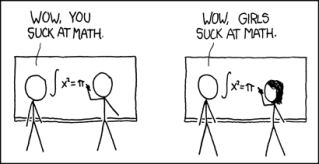
First, let me explain the title reference. As most of you know, I am a chemist. As a chemist I am a member of the American Chemical Society (ACS). The ACS is one of the best professional organizations in my opinion because of the data that it collects and analyzes for its members. One of the often-analyzed issues is what they call the “leaky pipeline,” which refers to the loss of women at each level of chemistry. Women now get more than 50% of chemistry B.S. degrees and 30% of Ph.D.s but are only 11% of chemistry professors at the top 50 universities.

Anyway, articles on the leaky pipeline appear on a regular basis in the society’s magazine Chemical & Engineering News. Someone must have brought one of the articles to Phyllis Schlafly’s attention because a few weeks after the story appeared, a letter from her appeared in the Letters to the Editor section (sorry no link, it’s several years old and subscriber only). In the letter she wrote her usual tripe about a women’s place but she brought out the big guns – data! She stated that since neither of her daughters were interested in science, that is proof that women aren’t good at science. (I don’t think any of her sons are scientists either, but don’t let that get in the way.)

A new study by Professors Janet Hyde and Janet Mertz (blogged here) at the University of Wisconsin (go Badgers!) strongly suggest that the gender gap is due to social factors, as many people have long suspected.

The duo of Janets have published a review that tackles the issue from three different angles. They considered the presence of outstanding female mathematicians. Looking beyond individuals, they found that gender differences in maths performance don’t really exist in the general population, with girls now performing as well as boys in standardised tests. Among the mathematically talented, a gender gap is more apparent but it is closing fast in many countries and non-existent in others. And tellingly, the size of the gap strongly depends on how equally the two sexes are treated.

Hyde and Mertz used a wide range of data sources, including the standardised maths tests that all US children must sit as a result of the No Child Left Behind Act. Last year, Hyde reviewed data from 7 million children across 10 states and found that neither gender had the edge in performance, regardless of ethnicity or grade, even in schools which had seen disparities in past decades. The duo also looked at data from the National Assessment of Educational Progress (NAEP), a programme that tests a random sample of students every year, and found that male and female 12th-graders had only “trivial differences” in terms of complex problem-solving.

The alternate hypothesis was about greater variability in intellect between men and women. In IQ tests, boys were much more likely to be in the top 1% and the lowest 1% even though the mean between the two genders was the same. This is the “men are more likely to be geniuses” argument, AKA the Larry Summers argument. The study addresses this as well.

To test that, Hyde looked at data from maths tests in Minnesota and compared the numbers of boys and girls who scored in the top 5% of their year. The ratio was 1.45, meaning that for every two girls in this elite group, there were around three boys. In the top 1%, the ratio was 2.06, meaning two boys for every girl. That seems to vindicate the Variability Hypothesis, but those figures only applied to white American children. In other ethnic groups or, indeed, in other countries, the picture was very different.

For Asian-Americans the ratio was actually 0.91, meaning more girls than boys in the top 1%. International studies have found similar trends. One analysis of tests from the Program for International Student Assessment (PISA) showed that 15-year-old girls matched or outnumbered their male peers in the top tiers within Iceland, Thailand and the UK. Two studies found that 15-year-old boys and girls were equally varied in their mathematical skills in most of the countries taking part in PISA and the Trends in International Mathematics and Science Study (TIMSS). In some, like the Netherlands, girls actually turned out to have the wider range of ability.

You can suck it, too, Larry Summers.

*h/t Jason, for the post title idea
Products Targeted to Women Generally Tick Me Off

There’s a new candy bar being introduced, and it’s targeted to women. Here are some of the descriptions:

Try it in public.

A chocolate bar that shimmers. Definitely eat it with the lights on.

Finally a chocolate you don’t feel so guilty about eating.

Under 85 calories per finger. That’s a sexy little figure. Just like yours.

It’s wrapped in pink. It glitters (they actually add mica to the candy). It has sexual innuendos. Apparently women are always on a diet, like pink and think chocolate is like sex. Or something.

I like pink and bling as much as the next gal, but I get a little tired of companies slapping pink labels on things and saying they’re for women. If I’m going to have chocolate, I’ll have some gourmet dark chocolate, not some glittery, pink-wrapped candy bars. Will companies ever realize that not all women like or want the same thing and that the quality of the product is the most important thing?

Feminist-Approved Insults

As we discussed yesterday in my inaugural post, sometimes common expressions grate on feminists the wrong way. The main objection is to describing things that are undesirable in feminine terms, most especially terms for the female anatomy. Listen, I know it’s a hard habit to break because it is so pervasive (that’s the problem!) so I thought I’d give a guide.

Don’t

  • Use “pussy” or other yonic terms to describe something as “bad” or “cowardly.”
  • Use the term “panties in a bunch” to describe an overreaction, especially if you’re talking about a man. Do use other terms for underwear that don’t specifically refer to a gender.
  • Use the term “like a girl” to mean something negative. I’ve seen for example “throws like a girl” to mean unathletic. I believe, though, that “like a girl” is a terminology just begging to be reclaimed.
  • Use the term “on the rag” or other implications of menstruation to imply that a woman is illogical or shouldn’t be taken seriously.
  • Do

  • Use the term “douche” or variations thereof. Why? Well, douche is something that is undesirable, part of the decades-long campaign to convince women that they are dirty and disgusting. Don’t even get me started on the current brazilian wax craze.
  • Use terms implying women = good. I’ve seen that the Urban Dictionary lists a definition of yonic as “cool.”
  • Neutral (Doesn’t provoke a strong reaction in me)

  • The term “bitch.” It has referred to a female dog, but the term has really just come to symbolize a woman you don’t like. There has to be some term for this!
  • The term “clutching pearls” for a prudish reaction. It does have a sort of feminine implication, but for some reason I always picture men doing this. Usually because they’re the ones leading the prude parade, I guess.

    Follow these guidelines to have a better relationship with the feminists in your life. If you don’t, you’re just a douche.