Tag Archives: Health Care

Public Option Health Care – It’s On!

Kudos to the House!

The Democratic Party showed on Friday what it’s capable of when led by the majority of its members rather than its conservative wing. In stark contrast to Senate Democrats, who spent the week backpedaling on reform, unified House Democrats unveiled a draft health care overhaul bill jointly endorsed by three powerful committee chairmen.

Finally, Democrats acting like they won an election.

Where the Senate Finance Committee’s outline of a bill didn’t include a public health insurance option for people to buy into, the House version includes a robust public plan that would operate nationally and compete with private insurers on a level playing field to keep them honest.

A robust public plan.  Now we’re talking.  And, it gets better.

While the Senate has cowered from the debate over a public option in the face of Republican and conservative Democratic opposition, Rangel said he relishes the battle.

In other words… Bring it on!

Frank Luntz Tells Them What to Say — Health Care Edition

Everyone who has paid attention to politics since Bill Clinton knows the name of Frank Luntz. He is a GOP pollster whose specialty is messaging. As in finding the words that either make it easier for people to emotionally engage on a position. Key to this effort is that truth or accuracy or anything near it is not crucial. Nor is it crucial to use language to educate people about the terms of the debate. Putting up slogans — often misleading as to their actual position is the game.

Yesterday morning I had one of those rare chances to listen to Al Mascitti for abit in my office. And who calls in? Mr. Shallow Bench who is telling Al that Luntz has done some amazing polling on what a health care plan needs to look like. This amazes me, because Luntz doesn’t do this kind of polling, so I went back to look at the Luntz findings, and it is still not a real poll on what people want or even their attitudes on an issue. These polls are designed to produce honest-to-god Talking Points. So take a good look at the Talking Points you’ll be hearing ad-infinitum from repubs for the next few months (and have been hearing already):

(1) Humanize your approach. Abandon and exile ALL references to the “healthcare system.” From now on, healthcare is about people. Before you speak, think of the three components of tone that matter most: Individualize. Personalize. Humanize.

(2) Acknowledge the “crisis” or suffer the consequences. If you say there is no healthcare crisis, you give your listener permission to ignore everything else you say. It is a credibility killer for most Americans. A better approach is to define the crisis in your terms. “If you’re one of the millions who can’t afford healthcare, it is a crisis.” Better yet, “If some bureaucrat puts himself between you and your doctor, denying you exactly what you need, that’s a crisis.” And the best: “If you have to wait weeks for tests and months for treatment, that’s a healthcare crisis.”
Continue reading

The Bankrupt Rhetoric of Rationing

Health care rationing that is.

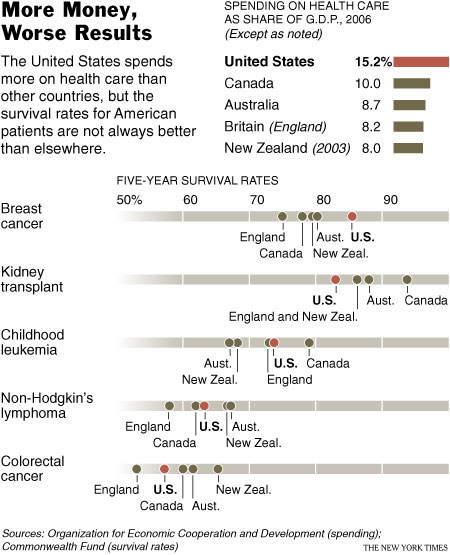
David Leonhardt at the NYT has another Must Read article detailing all of the ways that health care is rationed in the US.

Today, I want to try to explain why the case against rationing isn’t really a substantive argument. It’s a clever set of buzzwords that tries to hide the fact that societies must make choices.

He spends his article taking a look at how rationing is something of an economic fact of life (there aren’t many of us driving one of these) — the allocation of scare resources requires active management, actually making decisions about how those recourses are allocated. Except as far as our medical care is concerned, we don’t actively think about allocating medical resources. So there is a built in passivity (or avoidance behavior of the decisions) that is ratcheting up the cost of our care and ensuring that our outcomes are collectively in the middle of the pack. To that end, they’ve included a very cool graphic:

17leonhardt-graf01-2

Continue reading

Health Insurance Companies Always Win

Which is the basic problem, since insurance is really legalized gambling.  Whether it’s your house, health or car, you’re paying (betting) money in the hopes you never cash in on your investment.  Insurance companies are betting on the same thing, especially since they get your money up front.  And once they have your money they stack the deck… completely in their favor.

Executives of three of the nation’s largest health insurers told federal lawmakers in Washington on Tuesday that they would continue canceling medical coverage for some sick policyholders, despite withering criticism from Republican and Democratic members of Congress who decried the practice as unfair and abusive.

The hearing on the controversial action known as rescission, which has left thousands of Americans burdened with costly medical bills despite paying insurance premiums, began a day after President Obama outlined his proposals for revamping the nation’s healthcare system.

An investigation by the House Subcommittee on Oversight and Investigations showed that health insurers WellPoint Inc., UnitedHealth Group and Assurant Inc. canceled the coverage of more than 20,000 people, allowing the companies to avoid paying more than $300 million in medical claims over a five-year period.

It also found that policyholders with breast cancer, lymphoma and more than 1,000 other conditions were targeted for rescission and that employees were praised in performance reviews for terminating the policies of customers with expensive illnesses.

Hmm… so much for risk.  This practice of rescission is not only immoral and unethical it should be illegal.  The fact that it’s more like daily operating procedure designed to pump up profits displays one the most damning problems with For Profit health insurance companies.

Republicans and Democrats called them out on this practice, but the health insurance executives basically shrugged and would not commit to limiting rescissions to only policyholders who intentionally lie or commit fraud to obtain coverage, a refusal that met with dismay from legislators on both sides of the political aisle.”

Would not commit to limiting rescissions to only policyholders who intentionally lie or commit fraud? WTF?  Seriously, these companies have no shame, and while I’m not a litigious person I wouldn’t shed a tear if these companies were dragged into court over these “practices.”  How do they get away with this?  And can you imagine any other business behaving in such a way?

We need a public option – if for no other reason than giving the victims of rescission a place to go.  And if the insurance company shysters cry and complain… oh well, they’ll be crying alone.

Some Statistics on Health Care

I found these statistics in this great diary at Daily Kos. Mitch McConnell compared our health care system with Great Britain, Canada and New Zealand. Below is how we stack up against these 3 countries, all of which have some form of universal health care.

First, let’s look at per capita health care spending in those three countries, and in the United States:

United States: $5,274
Canada: $2,931
United Kingdom: $2,160
New Zealand: $1,857

Let’s look at the figures from a slightly different standpoint, total health care spending as a percent of GDP:

United States: 15.4%
Canada: 9.8%
New Zealand: 8.4%
United Kingdom: 8.1%

We’re definitely the most expensive, and we don’t cover everyone.

Here are the number of children, per thousand live births, who die in their first year of life in these same four countries:

United States: 6.3
Canada: 5.08
New Zealand: 4.99
United Kingdom: 4.93

Here are the years of life expectancy at birth for the total population (in all cases, the average woman lives a little longer than this, and the average man a little less than this):

Canada: 80.18 years
New Zealand: 79.62 years
United Kingdom: 78.95 years
United States: 77.71 years

Why are we still arguing about this? There are so many different models of how to do health care out there – why can’t we pick the best parts of these models?

Source material:
per capita health care spending (we’re #1!)
spending as a % of GDP (we’re #1!)
infant mortality rate (we’re not as good as Cuba, but better than the Faroe Islands #185 of 226 – highest number best)
life expectancy at birth (we’re #36!)

U.S. Health Care Doesn’t Measure Up

Can we please drop all this We’re #1 nonsense when it comes Health Care.  Seriously, we have nothing to brag about.

Despite having the most costly health system in the world, the United States consistently underperforms on most dimensions of performance, relative to other countries. This report—an update to two earlier editions—includes data from surveys of patients, as well as information from primary care physicians about their medical practices and views of their countries’ health systems. Compared with five other nations—Australia, Canada, Germany, New Zealand, the United Kingdom—the U.S. health care system ranks last or next-to-last on five dimensions of a high performance health system: quality, access, efficiency, equity, and healthy lives.

Mirror, Mirror ES1

Look at those costs?  We’re spending 6,102.00 per capita and we’re not #1 in quality, access, efficiency, equity, and healthy lives?   How is that possible?  And I would think that Republicans would be all over this obvious bloat and waste instead of making scary noises about rationing – which already occurs in our system – while screaming we’re the best – which we’re obviously not.

Our Health Care System is ridiculously expensive and ineffiecent.  It’s focus is not on saving lives, but rather on corporate profits – and it shows.

President’s Town Hall Meeting on Health Care

President Obama went to Wisonsin this week to conduct a Town Hall discussing efforts to fix the health care system.  This is abit over an hour long, but worth watching if you’ve only seen clips (the one where he gives the young woman a note for school seemed to be the news):

[youtube]http://www.youtube.com/watch?v=nvFqTVal_f0[/youtube]

I hope he does more of these.

Call Carper’s Office

Getting good healthcare reform is going to be one helluva fight. The “public option” is one of the most difficult parts of the plan. A good public option will help reduce healthcare costs by bargaining with providers and the for-profit companies are already mobilizing the opposition.

So they’re pulling out all the stops — pushing Democrats and a handful of so-called “moderate” Republicans who say they’re in favor of a public option to support legislation that would include it in name only. One of their proposals is to break up the public option into small pieces under multiple regional third-party administrators that would have little or no bargaining leverage. A second is to give the public option to the states where Big Pharma and Big Insurance can easily buy off legislators and officials, as they’ve been doing for years. A third is bind the public plan to the same rules private insurers have already wangled, thereby making it impossible for the public plan to put competitive pressure on the insurers.

Enter Olympia Snowe. Her move is important, not because she’s Republican (the Senate needs only 51 votes to pass this) but because she’s well-respected and considered non-partisan, and therefore offers some cover to Democrats who may need it. Last night Snowe hosted a private meeting between members and staffers about a new proposal Pharma and Insurance are floating, and apparently she’s already gained the tentative support of several Democrats (including Ron Wyden and Thomas Carper). Under Snowe’s proposal, the public option would kick in years from now, but it would be triggered only if insurance companies fail to bring down healthcare costs and expand coverage in he meantime.

What’s the catch? First, these conditions are likely to be achieved by other pieces of the emerging legislation; for example, computerized records will bring down costs a tad, and a mandate requiring everyone to have coverage will automatically expand coverage. If it ever comes to it, Pharma and Insurance can argue that their mere participation fulfills their part of the bargain, so no public option will need to be triggered. Second, as Pharma and Insurance well know, “years from now” in legislative terms means never. There will never be a better time than now to enact a public option. If it’s not included, in a few years the public’s attention will be elsewhere.

It’s pretty obvious that some politicians are only too happy to put a band-aid on the status quo (while taking credit for “reform.”) The public option has support of more than 60% of Americans, but the details matter. Pressure from the public has made some lawmakers back down from their opposition to reform (like Senator Ben Nelson of Nebraska).

Let’s put pressure on Carper for a real public option.

Contact info:

Washington, DC
Phone: (202) 224-2441
Fax: (202) 228-2190

Wilmington
Phone: (302) 573-6291
Fax: (302) 573-6434

Dover
Phone: (302) 674-3308
Fax: (302) 674-5464

Georgetown
Phone: (302) 856-7690
Fax: (302) 856-3001

One Medical Condition Away From Bankruptcy

WASHINGTON (Reuters) – Medical bills are involved in more than 60 percent of U.S. personal bankruptcies, an increase of 50 percent in just six years, U.S. researchers reported on Thursday.

More than 75 percent of these bankrupt families had health insurance but still were overwhelmed by their medical debts, the team at Harvard Law School, Harvard Medical School and Ohio University reported in the American Journal of Medicine.

Got that?  More than 75% had health insurance.

“Most medical debtors were well-educated, owned homes and had middle-class occupations.”

Hmm… sound like anyone you know?

The researchers, whose work was paid for by the Robert Wood Johnson Foundation, said the share of bankruptcies that could be blamed on medical problems rose by 50 percent from 2001 to 2007.

“Unless you’re Warren Buffett, your family is just one serious illness away from bankruptcy,” Harvard’s Dr. David Himmelstein, an advocate for a single-payer health insurance program for the United States, said in a statement.

“For middle-class Americans, health insurance offers little protection,” he added.

Is this really a sign of a great country?  Should having an illness or an accident be a standard reason for filing bankruptcy?

I know I write on this topic a lot, but it amazes me that there’s anything left to debate.  As a nation we should be ashamed that people’s lives are ruined simply because they became ill or injured – 75% who had health insurance.

Seems to me, the greatness of a country is judged on how they care for their young, old and sick.

Pop Quiz

The chart below shows the demographics of uninsured Americans.  Can anyone tell me which age group has the best coverage, and why?  Hint: This group also has the most health care needs.

uninsuredage

(h/t Yglesias)

The next chart I want to see is the one that compares Americans to members of Congress.

The Cost Culture of Health Care Delivery

This is a Must Read article by Atul Gawande at the New Yorker is worth spending some time with today. It is really difficult to excerpt anything here, but it is just that good. He gets at many of the real policy and practice questions that need to be thought about as we talk about implementing universal health care. And this is nicely done — comparing the average Medicare costs of two Texas cities, including one that is surprisingly included as one of the highest cost Medicare expenditures per capita.

This article is an excellent starting point for thinking about how to contain health care costs, while boosting health outcomes. What Congress is currently working on is getting more people covered, and cleaning up some of the insurance mess — but the business of cost containment is going to be a longer term and probably much tougher project.

Really, just read the whole thing.