Monthly Archives: February 2010

Psst! Your Shallow Bench is Showing

Potential Republican Congressional candidate, Anthony Wedo dropped out of the race Friday.  I believe that this leaves only Fred Cullis, the guy who had a half dozen people (mostly family and volunteers) at his announcement.  They really have no one.

I asked Charlie Copeland if he was running and he was pretty clear that he wasn’t, but who else is there?

I don’t feel sorry for them one bit.

Friday Afternoon Bacon Blogging — Wishing for a DL Road Trip Edition

There was a great article in the Philly News this week telling the world how the amazing DiBruno Bros is stepping up to add artisan bacon to its truely wondrous food offerings:

For aficionados of Vermont’s singular (but slowly fading) delicacy – cob-smoked hams and bacon – there was “Vermont Smoke and Cure” bacon from South Barre, Vt., thick-sliced, maple-cured, and smoked over, yes, corncobs, conferring subtle hint of sour. (This brand was subtler than some, the meat moistly pink and somewhat akin to Canadian bacon.)

There was Nodine’s out of Connecticut, the double-smoked and bayou-style, but not the juniper, which of course was being touted in the skinny aisles as the best of the lot.

There was bacon from a roadside smokehouse near Nashville, Tenn. A Missouri smoker was in touch.

Chipotle, black-pepper, and cinnamon-rubbed varieties were teed up. Ferguson had procured pricey ($8.99 for three ounces) bars of exceedingly lush, complex Vosges’ “Mo’s Dark [chocolate] Bacon Bar.” He handed out tastes of a sweet-smoky mayonnaise called “Baconnaise.”

Finally, in a prosaic plastic wrapper, one could find thick-cut bacon from Mountain Products Smokehouse, a modest, ranchhouse-sized smoker in LaGrangeville, in the Hudson Valley of New York.

Had you fried up a few slices with your egg Monday morning, you might well have been dumbstruck.

So this is what bacon could be, it might have dawned – its salt and cure so in sync; its smoke woven into the flavor, not simply into the aroma; the chew thoroughly meaty, with little trace of greasiness.

“It is,” ordained Ezekial Ferguson, “the steak of bacon.”

I brought back a bar of that Dark Chocolate Bacon Bar from California, but haven’t tried it yet. But that selection of bacon sounds awesome, and worth a road trip to Philly to stock up.

(h/t to Susan for the article!)

This is a Bacon Bouquet — linked to Delaware Liberal by anon last week in time for Valentines Day. Thanks anon, and my apologies for not getting to bacon blogging last week.

So — what food would you travel for?

Friday Open Thread

Woohoo, it’s Friday! Does anyone have any exciting plans for the weekend? Let’s get this open thread started.

On the lighter side, “20 Unholy Recipes: Dishes So Awful We Had to Make Them.” Interestingly, a lot of the recipes are from the 70s. They all look so awful, it’s hard to pick just one.
Jellied Chicken (yes, you read that right)

This recipe was taken from The Blender Way to Better Cooking — 200 pages of recipes, all requiring a blender. Enough said. Read more about this recipe here.

Intrigue!

Yesterday, reports the Philadelphia Inquirer, Sestak conducted a taping of Larry Kane: Voice of Reason, a cable news show. When Kane put the question to him directly, Sestak answered “yes,” but declined to elaborate.

Kane asked whether the job was Secretary of the Navy, to which Sestak, a retired Navy Admiral, replied: “No comment.” The current Navy Secretary is Ray Mabus, a Democrat and former Mississippi governor who campaigned extensively for Barack Obama in 2008.

Asked by Kane whether the job was “high-ranking,” Sestak said that it was, but added he would “never leave” the Senate race through such a deal.

The White House is denying making any kind of offer. The Sestak/Specter primary has not been getting a lot of attention recently and I’m not sure why. Perhaps Sestak is trying to heat things up a bit?

Metaphor Fail

Brand new Massachusetts Senator and conservative darling Scott Brown was interviewed on Fox (of course) and asked about the incident in Austin, Texas. His answer was interesting, to say the least.

Seriously. The new Republican Senator from Massachusetts went on FOX News this evening and was asked about the nut who crashed his plane into an IRS office building, because he hates the government. Here is what Scott Brown said, when asked about this possible act of terrorism:

“I don’t know if it’s related, but I can just sense, not only in my election, but since being here in Washington, people are frustrated, they want transparency, they want their elected officials to be accountable and open, and talk about the things that are affecting their daily lives. So I’m not sure if there’s a connection, I certainly hope not, but we need to do things better.

The best part is what comes next. Cavuto says, gosh, can you imagine people (read: liberals) claiming that this is what happens when you build up populist rage – isn’t that a bit extreme? Brown concurs. After suggesting that the populist rage that led this man to crash his plane into an IRS building was the same kind of thing that got him elected.

Uh….really? Scott Brown thinks his voters are like homicidal lunatic Joe Stack? I really am scared now.

Falling In Love Again

George Bush left office with approval ratings in the 20s. He was responsible for getting us into a disastrous war based on lies and for the worst recession since the Great Depression. For a year, Republicans had been quiet about Bush and it looked like Bush was about to be disappeared down the memory hole.

Republicans must really be feeling confident because Bush/Cheney love was making a reappearance at CPAC:

“When it comes to shifting responsibility for failure, however, no one is a more frequent object of President Obama’s reproach than President Bush,” Romney said in a campaign-style speech this afternoon. “I am convinced that history will judge President Bush far more kindly.”

Romney said that Bush deserves praise for his leadership after 9/11, when he said Bush ” pulled us from a deepening recession following the attack,” and for the passage of No Child Left Behind. Romney said Bush will be remembered for attacking the Taliban and waging “war on the Jihadists.” (Notably absent was a mention of the war in Iraq.)

The crowd didn’t just offer polite applause to these remarks, it cheered loudly (National Journal’s Erin McPike explores more instances of the Bush resurgence in Romney’s speech here). The enthusiasm from the CPACers and Romney over Bush was a surprise. At the Republican National Convention in 2008, Bush didn’t even show up to make a speech in person (at the time, the White House said he couldn’t make it because Bush was preparing for the aftermath of a hurricane bearing down the Gulf Coast.). Bush appeared by video, to polite applause.

So, despite all the talk about Republicans’ “rediscovered” fiscal discipline they really are the same ol’ Republicans.

Thursday Open Thread

It snowed last night! Why do you hate us Weather Goddess? In other news, it’s actually Thursday and the week is more than halfway over! Are you ready for your open thread?

But he seemed like such a nice, moderate guy:

Virginia Governor Bob McDonnell wasted little time overturning an order by his predecessor, Tim Kaine, that protected the state’s gay workers against discrimination. McConnell signed a non-discrimination executive order that left out the specific protection that was included when Kaine was governor. It was signed on February 5, but not reported until five days later.

I guess we know what Governor McDonnell’s priorities are now, in case you were wondering.

Have you ever wondered why ski jumping is the only sport without a women’s category?

It seems the issue is a hot topic this year and via this MSNBC.com video I finally have my answer. Although some very thin and lame excuses have been floated around, what it seems to boil down to is that the European men don’t want to be shown up by a bunch of girls, one of whom holds the record on the actual ski jump used at the Vancouver games.

Yes that’s right, Lindsey Van beat the men’s record on the exact same ski jump the men will be sliding down to claim their Olympic medals this week. I ask you: how fucked up is that?

This quote cracked me up:

In 2005, Gian Franco Kasper, FIS president and a member of the IOC, said that he didn’t think women should ski jump because the sport “seems not to be appropriate for ladies from a medical point of view.”

Gee thanks for looking out for ski jumpers’ lady parts! Women are just too stupid to make these kind of decisions. The IOC must be somewhat embarrassed by the attention:

Even worse is IOC member Dick Pound, who withdrew his head from his ass long enough to utter this asinine warning to the women ski jumpers:

“If in the meantime you’re making all kinds of allegations about the IOC and how it’s discriminating on the basis of gender,” he warned, “the IOC may say, ‘Oh yeah, I remember them. They’re the ones that embarrassed us and caused us a lot of trouble of trouble in Vancouver, maybe they should wait another four years or eight years.'”

Delawareans Hate Their Jobs

That is according to a recently released survey called the State of Well-Being (pdf) that has surveyed Americans and presented state-by-state reports on how people in that state view their lives. This is part of a long-term effort being produced by Gallup to provide some measure of American’s health and well-being.  And according to this study, Delaware ranks dead last among states for Work Environment, going down from last year’s ranking of 38th among the states.  Here’s a summary of the data:

Index Score State Rank
Category 2008 2009 2008 2009
Overall well-being 64.7 64.7 36 38
Life Evaluation 39.5 46.4 31 19
Emotional Health 77.2 78.1 45 32
Physical Health 74.8 75.6 43 35
Healthy Behavior 62.7 62.8 31 24
Work Environment 49.6 42.6 36 50
Basic Access 84.2 82.8 20 22

Dead last in job satisfaction. Probably the only people who are happy about their job prospects are bankers of the Wall Street type. And unemployment has hit hard here as it would in a small place where people know each other. But given that most of Delaware’s major business sectors have had very difficult sailing, these numbers may tell a more interesting tale. Government, banks, insurance, agriculture and tourism dominate the economy here, and every one of them has taken something of a hit over the past 12 months — layoffs, furloughs, increased benefits costs, loss of benefits, requirements for more hours for those that are left are probably part of it. And there doesn’t seem to be much relief from these reductions and impositions on workers any time soon. Plus some of these are in industries pretty notoriously not all that interested in Employee Satisfaction.

The better news here is that Delaware ranks pretty highly Life Evaluation (an assessment of your life now and what you think your life will be in 5 years) and increased its ranking over last year. We increased our overall ranking in other categories too (not Basic Access, though), so it looks like overall we are taking better care of ourselves and feeling pretty good about our lives — it is just that Work. Sucks.

So what do you think? Would your life be considerably improved if you could somehow change or eliminate your employer?

I Would Like To Thank Health Insurance Companies For Making My Point

I’m certain everyone has heard of Anthem’s 39% rate increase in health insurance, but did you realize raising rates is all the rage?  Actually, if you’re one of the individually insured these rate hikes aren’t new at all.  They’re simply part of individual health insurance.

At 11:30 a.m. today, Sebelius will release the report, obtained by TPMDC and titled “Insurance Companies Prosper, Families Suffer: Our Broken Health Insurance System.”

It finds that Anthem’s rate increase (now delayed until May) is “not unique” and that experts say premiums will keep rising.

The report quotes National Association of Insurance Commissioners officials predicting the nation will “see rate increases of 20, 25, 30 percent.”

“These massive increases are disturbing examples of the problems that make reforming our health insurance system more important than ever,” the report states.

Why these companies must be suffering financially.   Or not…

Last year, as working families struggled with rising health care costs and a recession, the five largest health insurance companies – WellPoint, UnitedHealth Group, Cigna, Aetna, and Humana – took in combined profits of $12.2 billion, up 56 percent over 2008.

These health insurance companies’ profits grew even as nominal GDP decreased by 1 percent over this same time period.

And recent data show that the CEOs of America’s five largest insurers were each compensated up to $24 million in 2008.

Those are some really big profit numbers.

But it’s the timing of these rate hikes that confuses me and makes me think these companies have jumped the gun on returning to business as usual.  You’d think they’d lay low until HCR was officially pronounced dead.  This move has breathed new life into the patient, and strengthens – in tangible, immediate ways – what we’ve been saying all along, that the system is broken and cannot be sustained.

Something else interesting is happening in HCR.  The Public Option has returned, and is gaining support.

So I’d like to take this moment to thank the Health Insurance Industry for simply being you.

Warm Up Your Dialing Fingers

Next week President Obama will convene his bipartisan health care summit. It’s expected that sometime in next few days, the Senate bill + reconciliation sidecar will be introduced. The reconciliation bill is to correct some of the issues that the House had with the Senate bill. We don’t know exactly what’s in it but it’s thought to remove the health insurance company anti-trust exemption, remove the special Medicaid deal for Nebraska and introduce a fix for the excise tax (still the major sticking point).

There’s now another push to introduce a public option through reconciliation. I’m not sure if this will be a separate bill or part of the reconciliation package. Right now, 14 Senators have signed on (we need 50). The 14 Senators are Michael Bennet, Kirsten Gillibrand, Jeff Merkley, Sherrod Brown, Al Franken, Pat Leahy, John Kerry, Sheldon Whitehouse, Roland Burris, Bernie Sanders, Dianne Feinstein, Amy Klobuchar, Ben Cardin and Carl Levin. Neither Ted Kaufman or Tom Carper have signed on, so let them know what you think. There’s a script for the call if you want one, and also a petition you can sign. Be sure to tell them 1) you want health care reform to pass, no more delaying and 2) pass a public option through reconciliation.

The public polling supports passing health care reform. In fact, the newest poll showed that opposition to health care reform is mostly from people who would never vote for Democrats anyway (1% approve, 94% oppose among the 37% who definitely won’t vote Democratic). Among people who would consider voting for Democrats (30% who would consider, 34% who definitely will) 64% approve of passing reform, with only 22% opposed.

The public wants Democrats to deliver on their promise of change. No more excuses, no more wringing of hands. Pass it and then sell it. The people opposed may be loud, but they aren’t the majority.

Contact Tom Carper
Contact Ted Kaufman

Mt. Vernon Statement

Conservatives had an event for the launch of the CPAC conference where they unveiled a new document called the “Mt. Vernon Statement.” This is a statement of conservative principles that they expect all Republicans to sign.

The Mount Vernon Statement

Constitutional Conservatism: A Statement for the 21st Century

We recommit ourselves to the ideas of the American Founding. Through the Constitution, the Founders created an enduring framework of limited government based on the rule of law. They sought to secure national independence, provide for economic opportunity, establish true religious liberty and maintain a flourishing society of republican self-government.

These principles define us as a country and inspire us as a people. They are responsible for a prosperous, just nation unlike any other in the world. They are our highest achievements, serving not only as powerful beacons to all who strive for freedom and seek self-government, but as warnings to tyrants and despots everywhere.

Each one of these founding ideas is presently under sustained attack. In recent decades, America’s principles have been undermined and redefined in our culture, our universities and our politics. The selfevident truths of 1776 have been supplanted by the notion that no such truths exist. The federal government today ignores the limits of the Constitution, which is increasingly dismissed as obsolete and irrelevant.

Some insist that America must change, cast off the old and put on the new. But where would this lead — forward or backward, up or down? Isn’t this idea of change an empty promise or even a dangerous deception?

The change we urgently need, a change consistent with the American ideal, is not movement away from but toward our founding principles. At this important time, we need a restatement of Constitutional conservatism grounded in the priceless principle of ordered liberty articulated in the Declaration of Independence and the Constitution.

The conservatism of the Declaration asserts self-evident truths based on the laws of nature and nature’s God. It defends life, liberty and the pursuit of happiness. It traces authority to the consent of the governed. It recognizes man’s self-interest but also his capacity for virtue.

The conservatism of the Constitution limits government’s powers but ensures that government performs its proper job effectively. It refines popular will through the filter of representation. It provides checks and balances through the several branches of government and a federal republic.

A Constitutional conservatism unites all conservatives through the natural fusion provided by American principles. It reminds economic conservatives that morality is essential to limited government, social conservatives that unlimited government is a threat to moral self-government, and national security conservatives that energetic but responsible government is the key to America’s safety and leadership role in the world.

A Constitutional conservatism based on first principles provides the framework for a consistent and meaningful policy agenda.

* It applies the principle of limited government based on the rule of law to every proposal.
* It honors the central place of individual liberty in American politics and life.
* It encourages free enterprise, the individual entrepreneur, and economic reforms grounded in market solutions.
* It supports America’s national interest in advancing freedom and opposing tyranny in the world and prudently considers what we can and should do to that end.
* It informs conservatism’s firm defense of family, neighborhood, community, and faith.

If we are to succeed in the critical political and policy battles ahead, we must be certain of our purpose.

We must begin by retaking and resolutely defending the high ground of America’s founding principles.

February 17, 2010

So, after reading that do you think Republicans are pro-choice and anti-DADT now? Also, doesn’t it just spell out their sense of victimhood?

Each one of these founding ideas is presently under sustained attack. In recent decades, America’s principles have been undermined and redefined in our culture, our universities and our politics.

They are anti-university?

Personally, it sounds like a whole lot of nothing and even Richard Vigurie agrees with me:

This is embarrassing. If the people in the leadership of the conservative movement are going to put out pablum like this, the tea party people are going to make them seem irrelevant. And the tea party people are going to march to the forefront. This is almost as if the movements leaders were taken over by Tom DeLay and John Boehner.

Vigurie signed the document anyway.

A Big Picture Look At the Stimulus One Year On

And it is — on the terms it was passed — a definite success.

David Leonhart wrote this must read article at the NYT on Tuesday, that starts like this:

Imagine if, one year ago, Congress had passed a stimulus bill that really worked.

Let’s say this bill had started spending money within a matter of weeks and had rapidly helped the economy. Let’s also imagine it was large enough to have had a huge impact on jobs — employing something like two million people who would otherwise be unemployed right now.

If that had happened, what would the economy look like today?

Well, it would look almost exactly as it does now. Because those nice descriptions of the stimulus that I just gave aren’t hypothetical. They are descriptions of the actual bill.

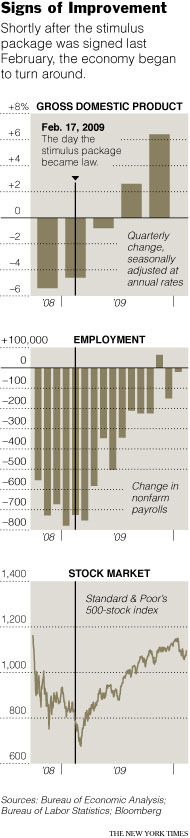
Leonhardt then goes on to survey the assessments of some of the independent economic research firms (they find that 1.6 million to 1.8 million jobs were added so far and that its ultimate impact will be an addition of roughly 2.5 million jobs. But there’s more — there’s graphs:

These are real signs of real improvement — certainly improved from this time last year when we were rapidly descending into the worst recession since WWII. It is not enough improvement, and that is largely a consequence of not asking for and not passing a large enough stimulus package. And employment is pretty much always the last thing to recover. The last one ended in November 2001 and unemployment kept rising until June 2003 hitting 6.3%. This economy is still delveraging and credit is still tight — meaning that cash for growth will be slow in coming.

But all that argues for is more stimulus spending — we still have massive infrastructure needs — and it argues for better PR for the current program. People are probably driving by ARRA signs all over their states and not getting that these are all stimulus projects.