

Culinary Spontaneity? I’m all for it!. Sure beats three squares a day:
One of the stupidest things in an earnest but stupid school of culinary thought is that each of the three daily meals should be ‘balanced’.” So argues American food writer MFK Fisher in her 1942 book How to Cook a Wolf. She goes on: “In the first place not all people need or want three meals each day. Many of them feel better with two or one and one-half, or five.”
Fisher wrote her book ostensibly as a guide on how to feed yourself pleasurably and nourishingly during a period of food shortages caused by war, but there is much in her insightful advice to inspire and provoke us today. More than 80 years later, threats to the sacred breakfast-lunch-dinner mode of eating can still make the news: “A nation of snackers: Britons no longer eat three meals a day”, gasped one recent headline in the Times. Deviations from the “standard” model are the subject of research by academics and health professionals, and food retailers commission studies in an attempt to understand (and shape?) when and how customers consume their food.
The idea that we should sit down for three meals at roughly the same time every day has become such an essential part of how we organise our lives – even when we’re failing to do it – that we forget it isn’t the natural order of things. Instead, it is a regime that was created not to serve the needs of our bodies or to give us pleasure, however much we may have managed to adapt it for these purposes – but to fit in with a day of labour. Like many of the ways that we live now, it has its roots in the Industrial Revolution: that was when breakfast became a brief meal eaten before the working morning, lunch something light but fortifying to be wolfed down quickly in the days before breaks were paid, and dinner a final sitting when everybody had finished in the evening. Before this people had of course eaten meals but they were made up of different foods and historically slipped around in terms of timing.
Rigid industry-dictated slots for eating in turn created opportunities for tycoons to mould our tastes and behaviours, including John Harvey Kellogg, who did much to influence breakfast as we know it. He and fellow members of the Seventh-day Adventist church set up sanatoriums in the US in the late 19th century as part of the “healthy living” movement and it was here that the promotion of bland breakfasts like cereal – “a pale pabulum made of wheat”, as Fisher had it – became linked with teachings on moral correctness.
Fisher paints an appealing picture of the alternative to fixations on structure and balance: “The best answer … is to have such good food and such generous casseroles and bowls and platters of it, that there cannot be even a conditioned appetite for more, after the real sensuous one is satisfied.” You can see traces of this in contemporary ideas of “intuitive eating”, an approach that emerged in reaction to punitive dieting cultures, which encourages letting go of the concept of “forbidden” or “bad foods” and incorporating eating habits otherwise seen as transgressive, including snacking. The problem is that the responsibility to provide food, be it a full meal or a snack, continues overwhelmingly to fall on women, and “foodwork” is still distributed unevenly along gendered lines in households.
We Could’ve Had Hybrid Cars More Than A Century Ago. But America’s Oligarchs Nixed It:
In October 1914, as gas cars were tightening their grip on America’s roads, Frank W. Smith, president of the Electric Vehicle Association of America, stood before a convention in Philadelphia and declared victory. Electric cars, he said, were “absolutely and unquestionably the automobile of the future, both for business and pleasure.” With mass production and a wider network of charging stations just around the corner, “it is only a matter of time,” he promised, “when the electrically propelled automobile will predominate.”
The future Smith imagined would not show signs of life for nearly 100 years, but it might have come far sooner had America’s industrial leaders stopped treating automotive power as a binary choice between gasoline and electricity. A compelling alternative lay in between. Hybrid power was cleaner and capable of guiding transportation through a more climate-friendly century while batteries and charging infrastructure matured. But by the time a suitable hybrid arrived—just two years after Smith’s proclamation—the world had already committed itself to gas.
Thomas Edison, like many, believed electric cars would ultimately prevail over gas. Obsessed with improving battery technology, Edison saw the electric automobile as a natural extension of his life’s work in electricity. Even though he was friends with Henry Ford, and encouraged Ford to develop internal combustion engines, Edison reportedly dismissed gas cars as noisy and foul-smelling, praising electricity as cleaner and simpler. In the early years of the automobile age, the quiet hum of electric motors, not the explosion of gasoline, seemed inevitable.
But by 1916, the Ford-Edison electric car still hadn’t materialized. There was some speculation—never proven—that oil tycoons, like John D. Rockefeller, had persuaded Ford to kill the project, but even without such pressure, electric car technology just wasn’t competitive with gas.
Batteries, which were predominantly lead-acid or nickel-iron, were too inefficient, too heavy, and too slow to recharge for the kind of fast-paced, mass-market automotive world consumers were beginning to demand. Plus, in 1916, electricity was scant outside cities.
But even as gas cars surged, an engineer named Clinton Edgar Woods offered a different solution. Instead of choosing between electricity and gas, he combined them, creating the first commercially viable hybrid vehicle.
Popular Science announced Woods’s new hybrid car with fascination in 1916. “The power plan of this unique vehicle,” the magazine explained, “consists of a small gasoline motor and an electric-motor generator combined in one unit under the hood forward of the dash, and a storage battery beneath the rear seats.” Woods named the car the Dual Power, referring to its twin power sources. Today, we call it a hybrid.
Woods’s car did not threaten gasoline’s emergence; it promised to leverage it. Where Ford, Edison, and Smith were focused on pure electric, Woods offered a compromise. His hybrid was designed to preserve the elegance and smooth operation of electric motors while conceding the practical power and range that fuel offered. His car offered dynamic braking with regenerative capabilities, using the motor to slow the car and recharge its battery, a feature that would not be seen in cars for another century. It also eliminated the need for a clutch, simplifying operation of the gas engine, just like an automatic transmission. And his design used gas power to recharge the batteries, a must where electricity was unavailable.
The Solar-Powered Rubbish-Eating Boat–Sounds Like A Win-Win:
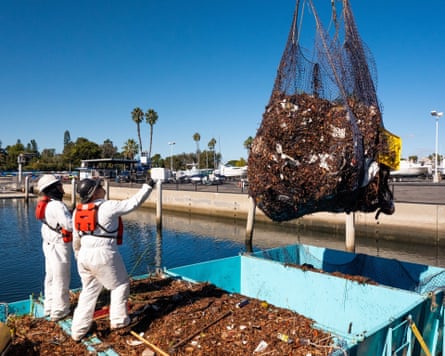
Ocean Cleanup aims to clean up the 30 most-polluted cities by 2030. Photograph: Ocean Cleanup
On an overcast June morning, I step from the rubber-sided Zodiac boat on to a floating barge at the mouth of Ballona Creek, where it meets Santa Monica Bay on the west side of Los Angeles. The first thing I notice? Salty air is the only smell, despite six giant waste bins sitting atop the tennis court-sized barge.
The contraption is actually two barges – a smaller platform sits nestled inside the larger boat. A floating barrier directs rubbish into the device, where a conveyor belt scoops it up. An automated shuttle then distributes the waste into six dumpsters on a separate barge, sending an alert to crews when it is full. Above, solar panels form the ceiling and a conveyor belt runs slowly, dropping bits of plastic and waste into each of the bins. The whole thing can hold about 20,000lbs (9,070kg) of rubbish – the same as one fully loaded lorry.
Since it is the dry season in LA there is not much waste being washed down the river by rainfall. But I still see what the problems are: polystyrene takeaway containers, noodle cups, bottle caps, a yellow pencil, a palm frond dotted with colourful pieces of microplastics. They are all caught up in the boat’s conveyor belt. It’s a pretty representative sample, says James Patterson, the operations manager with the nonprofit Ocean Cleanup, which created the system. “You get a wide variety of basic plastics – a lot of bottles, cups, to-go containers, things from restaurants. That’s typically what we see out here,” he says.
Cue Spirit, one of the greatest shoulda-been bands in rock history:

