

If you were to judge by public-opinion polling, you might reasonably conclude that Americans have broadly given up on the idea of going to college. In 2013, 70 percent of adults surveyed by Pew said that a college education was “very important.” This year, only 35 percent did. Over the same time period, the share of Americans who believe that college is “not worth the cost” rose from 40 to 63 percent, according to NBC.
If you were to judge, instead, by the choices that Americans are actually making, you might draw a different conclusion. Despite the reported skepticism of higher education, enrollment in four-year colleges and universities is growing. These institutions awarded 2 million bachelor’s degrees in 2023, compared with 1.6 million in 2010, and the fraction of 25-year-olds with a bachelor’s degree has steadily increased for the past 15 years. Even as Americans tell pollsters that college isn’t worth it, their behavior suggests that they still recognize the value of a degree for themselves and their children. And they’re correct to do so.
For the overwhelming majority of graduates, the returns on going to college more than offset the cost of tuition. The college wage premium—the difference in earnings between people with only a high-school diploma and people with a four-year college degree—surged in the 1980s and ’90s and has remained close to those historic highs for the past two decades. One recent analysis found that the average person with a bachelor’s degree earns about 70 percent more than a high-school graduate with a similar amount of work experience. Researchers at the Cleveland Fed recently estimated that the college wage premium will stand at 76 percent in 2042. Even though plenty of young people struggle in the job market right after graduation, a college degree tends to unlock more lucrative career paths with greater long-term opportunities for advancement.
And despite the proliferation of headlines about the skyrocketing cost of attending college, most American students are paying less in tuition than they were a decade ago. After factoring in financial aid, the cost of attending a public four-year college has fallen by more than 20 percent since 2015, even before adjusting for inflation. Prices at private universities have modestly increased over the same time period, but are down by 12 percent after adjusting for inflation. Even after accounting for student-debt payments, the average college graduate nets about $8,000 more a year than someone with only a high-school diploma.
Another myth busted. Perhaps.
Kill Your Lawn. It takes work, but it’s worth it. Just ask deer, foxes, honeybees, butterflies, hummingbirds, etc.:
EASIEST, LAZIEST (and that’s ok) METHOD : JUST START PLANTING STUFF, WHILE CONTINUING TO WEED-WACK AND MOW THE LAWN AROUND THE STUFF YOU PLANT.
The key take-away no matter what is that after you kill the lawn, you will essentially be planting and nurturing the natives, while continuing to go in and periodically remove or weed-wack/spray/dig-up-with-a-garden-knife any remaining bits of grass that pop up. I highly suggest against using herbicide unless you have one of the very invasive and aggressive grass species like Bermuda or Kikuyu Grass. St. Augustine Grass, by comparison, is easy to remove and kill.
The process of constant maintenance works because the native shrubs you initially plant (which should be easy to grow, common keystone members of your local ecosytem) will eventually outcrowd and overgrow the invasive grasses, and you will be the disturbance force that selects for the natives and selects against the attempted re-intrusion of the grasses. After a long growing season where you have watered the natives, any competition will successfully be put at bay since the natives have taken most of the available light and root space. Once you have reached this point, very little continued maintenance is necessary, especially for prairie gardens since prairies tend to be so dense.
We did the cardboard and mulch approach. It’s working…
Another Great Artist You’ve Never Heard Of. One of my infrequent, yet ongoing, Sunday themes:
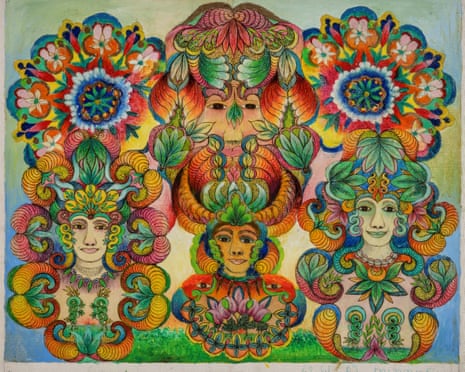
Minnie Evans, Untitled (Four Figures Collage), 1961–1967. Photograph: Collection of John Jerit. © The Estate of Minnie Evans
The Whitney Museum of American Art’s new show, The Lost World: The Art of Minnie Evans, offers audiences an opportunity to contemplate just how its subject may – or may not – have been an outsider to the art world, and to also revel in Evans’s increasing insiderness in the decades since her death in 1987. A comprehensive retrospective with nearly 100 pieces covering the entirety of Evans’s artistic output, the show occurs almost exactly 50 years after the Whitney first introduced the artist’s genius to New York’s art elite.
Born in 1892, Evans created her first artwork in 1935, just a few days after the death of her grandmother, when she drew two claustrophobic pen and ink pieces that she fittingly titled My Very First and My Second. Made on scraps of paper, they are obsessive and maze-like, composed mainly of seemingly abstract jags and spirals, with closer inspection revealing what appear to be a few recognizable forms: a rainbow and sun, a field of crosses that may be a graveyard, and a canoe-like vessel containing three passengers.
According to the Whitney curator Barbara Haskell, after dutifully signing and dating these pieces, Evans did not create so much as a single piece for another five years, until she had a chance encounter with these artworks as a sign that she should continue. “She painted all the time as a child, but then when she got married, she stopped making art,” said Haskell. “And then, in 1940, she took it up again.”
From there, Evans would create with an inspired fervor, largely fitting art-making into quiet moments during her employment as a housekeeper at the estate of the financier Pembroke Jones, and then later as a gatekeeper at the estate’s Airlie Gardens. What propelled her forward was tantamount to a religious calling.
“She felt that she saw God speaking to her from behind a wreath, three times, like this three-part conversion, and the third time she heard Him tell her to paint or die. So she had this divine calling that she felt she was answering,” Haskell said.
Evans’s art is dense and inspired: forms repeat in dazzling arrays, beings are decorated with a level of detail almost too tiny to believe, and mandala-like faces sport endless curves and crevices that become spaces for Evans’s exacting use of color and shading. Biblical imagery is frequently found, as well as lush, almost tropical-feeling depictions of greenery and flowers.
Colorado River’s Screwed, Man:
The Colorado River is fed primarily by snowmelt from the four states in the river’s Upper Basin (Colorado, Utah, New Mexico, and Wyoming), which then supplies the Lower Basin states (California, Arizona, and Nevada). Lakes Powell and Mead are crucial reservoirs that bring water to those lower states.
A winter of record-breaking warm temperatures across the West—made much more likely by climate change—and some of the lowest snowpack on record in mountain ranges in multiple states has led to an incredibly dry season for the Colorado. On Thursday, Lake Powell was sitting at 3,519.4 feet, while Lake Mead was at 1,039.6 feet, their lowest levels on record. Both reservoirs will hit what’s known as “deadpool” at certain levels (3,370 feet for Lake Powell, and 895 feet for Lake Mead), meaning that water can no longer flow out of the reservoirs downstream. (Hydropower from dams on both reservoirs will be affected, or go offline entirely, even earlier.)
In a stroke of uniquely terrible timing, the river, whose water has for decades been over-allocated to thirsty industries like agriculture, is also facing a political crisis. A century-old compact dictating water rights from the river runs out at the end of this year, and states have missed several deadlines to figure out who gets what in the future, requiring the federal government to step in. Combined with the dismal water levels at Lakes Powell and Mead, it’s a terrifying situation for experts who have been watching the slow-motion crisis on the river suddenly accelerate.

