

Guest post by Nathan Arizona
The statue of President James A. Garfield has left Wilmington before most people even knew it was here. No longer does he stand on a tiny Concord Avenue lawn across from the Kreston liquor store and next to a brick house whose windows he could easily peer into if he turned around. James Garfield is now in Ohio.
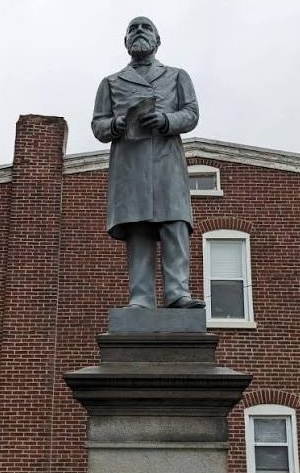
And no longer will those who did know about it ask themselves, Why is there a statue of James Garfield in Wilmington? The only reason seems to be that he was assassinated in 1881 by our old friend the “disappointed office seeker,” after serving for just six months. Assassinated presidents tend to get memorialized, even in cities where they otherwise have no connection.
But Garfield was recently driven 385 miles to a place where he does have a connection, Hiram, Ohio. He was a student at the college there and later the principal. He now stands on a lawn in front of the Hiram Village Hall, a small brick building that also looks like a house somebody might live in. There was already another Garfield statue nearby. They love them some Garfield.
Our crack team of reporters at the Facebook Hiram bureau said the city of Wilmington wanted to give away the statue and even paid for its transport. Hiram’s mayor explained, “The section of town where it was located was once glorious, but now it’s a less-than-glorious location. They thought it would be a good idea to bring him home.”
Garfield was hardly an embarrassment to the city. The moderate Republican had a good record on civil rights and, importantly, did not own slaves. In fact, he had been a Union general in the Civil War. In recent surveys Garfield has been ranked in the low 20s among the 45 U.S. presidents.
The statue weighs about 20,000 pounds and is 17 feet tall. It used to be taller. The movers left part of the stone pedestal behind. At least they didn’t cut him off at the knees.
The zinc statue had been moved once before but within the city. It was put up in 1895 at the intersection of Delaware Avenue, Washington Street and 11th Street. In 1916 a road widening project required a relocation and off it went to a tiny lawn on Concord Avenue.
So the score now is Hiram 2 Garfield statues, Wilmington 0. Let’s hope he doesn’t run into any disappointed office seekers out there.


Here is the story as I learned about it from John Medkeff on Facebook –
“WAS WILMINGTON’S HISTORIC GARFIELD STATUE GIVEN AWAY WITHOUT PROPER LEGAL AUTHORIZATION?
For more than 130 years, the statue of President James A. Garfield was part of Wilmington’s historic landscape. Erected in 1895, it was more than a monument—it was a cultural asset belonging to the people of Wilmington.
Now, the statue has been shipped to Hiram, Ohio, apparently as a permanent donation, with Wilmington taxpayers reportedly paying for its transportation.
But was this transfer even legally authorized?
The decision appears to have been made without the mayor’s consent, City Council approval, meaningful public notice, or an opportunity for the broader scope of Wilmington residents to be heard.
Wilmington’s City Charter and Code of Ordinances establish procedures governing the disposal of municipal property. Section 6-116(d), for example, addresses the disposal of unserviceable personal property and includes requirements concerning public notice and bids.
If those requirements were not followed, and no other lawful authority existed for the transfer, the disposal of this historic monument may have violated the City’s own laws.
Wilmington residents deserve answers to several serious questions:
Who authorized the transfer? Did that official have the legal authority to permanently give away a city-owned historic monument without City Council approval?
Was the law followed? Was the statue formally declared unserviceable, and were the required procedures under the City’s Charter and Code satisfied?
Why was the public excluded? Why wasn’t the proposed disposal discussed by City Council or opened to public scrutiny?
Apparently, someone in City government authorized the $21,500 be taken from the taxpayers’ coffers to pay for removal and transport of the statue to Ohio free of charge.
Were local alternatives considered? Did the City explore preserving the statue elsewhere in Wilmington or Delaware before giving it away?
Can the statue or public funds be recovered? If the transfer was improperly authorized, what legal remedies are available?
This is not simply a disagreement over where a historic statue should stand. It raises legitimate questions about whether Wilmington officials acted within their legal authority when disposing of public property.
The people of Wilmington have a right to know whether their city government followed the law, protected public assets, and responsibly spent taxpayer money.
City Council should independently examine the transaction, obtain a written legal determination from the City Solicitor, and make the findings public.
A historic cultural asset that belongs to the people of Wilmington should not be permanently relinquished without lawful authorization and appropriate public accountability.
Was the Garfield statue legally disposed of—or was a public asset given away without the authority and procedures required by law?
Wilmington residents deserve a clear, documented answer. This afternoon, I’ve called on Mayor Carney and the members of City Council to get to the bottom of this and provide an explanation. “