The Full Speech
I will more on this later in the Open Thread.
The son of two teachers and a lifelong Delawarean, John Carney is a strong, independent voice for our state. Serving in his third term as Delaware’s lone Congressman, John has established a reputation as a pragmatic leader who puts results over rhetoric.By virtue of his parents being teachers, I do happen to think Carney has a little more working class in him than most modern Democrats. Of course he went to private school, one of the lesser Ivies for college, and followed that up with his entire adult career in politics, so whatever working class was there is no doubt long gone. The part about "putting results over rhetoric"..? What results? Hopefully we'll soon find some in the rest of bio.
Clinton’s primary victory will allow her to assemble a Democratic Dream Team of political talent to rally the party and take on Trump. She’ll have Bill Clinton, a popular ex-president who can testify to her character and defend her record better than anyone (his speech defending President Obama’s at the 2012 convention is the stuff of legend); Elizabeth Warren, a liberal icon in the Senate who has already begun to prosecute the party’s sharpest case against Trump; [and] Joe Biden, a beloved vice president with a working-class, tell-it-like-it-is, God-knows-what-he’ll-say kind of appeal[.] Clinton will also have by her side the best political player in the game: Barack Obama. In a few months, my old boss will hit the trail for the last time as president. He’ll do so with an approval rating that has been north of 50 percent nearly every week since March, a high he’d previously reached only in the months after his first and second elections. Political scientists point to a strong historical correlation between an outgoing president’s popularity and the final vote share of his party’s candidate. Obama’s recent surge in popularity has been driven largely by independents, young people, women, and Latinos — four groups most likely to tip the election toward Clinton. He has an 82 percent approval rating among Sanders supporters, whom he’ll work to persuade as America’s most famous Clinton convert — someone who also waged a brutal primary against her, but eventually became a friend, partner, and champion. I don’t want to overestimate the Obama effect. No one can win this for Clinton but Clinton. [...] But I suspect that the president will give this campaign all that he has and more — for Clinton, for his own legacy, and for the vision of America that he’s asked us to believe in since the night he stepped onto the national stage in Boston and delivered his 2004 convention speech, a hopeful, bighearted vision that is the antithesis of everything that Trump represents. The truth is, Obama has understood better than most the forces that gave rise to a candidacy like Trump’s.
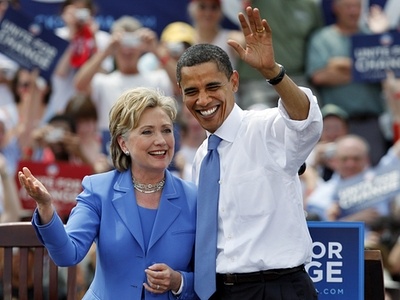
From Mike Mahaffie on Flickr.
There are a lot of reasons — internal, external, historical — for the way Clinton deals with the public, and the way we respond to her. But there is something about the candidate that is getting lost in translation. The conviction that I was in the presence of a capable, charming politician who inspires tremendous excitement would fade and in fact clash dramatically with the impressions I’d get as soon as I left her circle: of a campaign imperiled, a message muddled, unfavorables scarily high. To be near her is to feel like the campaign is in steady hands; to be at any distance is to fear for the fate of the republic. [...] When I asked her why she thinks women’s ambition is regarded as dangerous, she posited that it was about “a fear that ambition will crowd out everything else — relationships, marriage, children, family, homemaking, all the other parts [of life] that are important to me and important to most women I know.” She also mentioned the unappealing stereotyping: “We’re so accustomed to think of women’s ambition being made manifest in ways that we don’t approve of, or that we find off-putting.”