Imagine if, one year ago, Congress had passed a stimulus bill that really worked.
Let’s say this bill had started spending money within a matter of weeks and had rapidly helped the economy. Let’s also imagine it was large enough to have had a huge impact on jobs — employing something like two million people who would otherwise be unemployed right now.
If that had happened, what would the economy look like today?
Well, it would look almost exactly as it does now. Because those nice descriptions of the stimulus that I just gave aren’t hypothetical. They are descriptions of the actual bill.
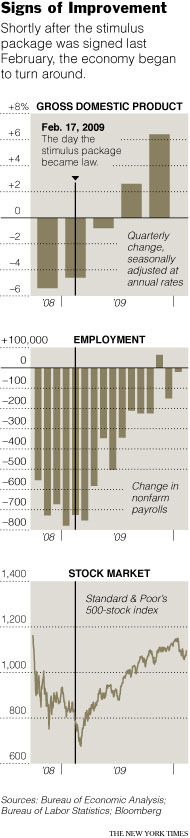
Leonhardt then goes on to survey the assessments of some of the independent economic research firms (they find that 1.6 million to 1.8 million jobs were added so far and that its ultimate impact will be an addition of roughly 2.5 million jobs. But there’s more — there’s graphs:
These are real signs of real improvement — certainly improved from this time last year when we were rapidly descending into the worst recession since WWII. It is not enough improvement, and that is largely a consequence of not asking for and not passing a large enough stimulus package. And employment is pretty much always the last thing to recover. The last one ended in November 2001 and unemployment kept rising until June 2003 hitting 6.3%. This economy is still delveraging and credit is still tight — meaning that cash for growth will be slow in coming.
But all that argues for is more stimulus spending — we still have massive infrastructure needs — and it argues for better PR for the current program. People are probably driving by ARRA signs all over their states and not getting that these are all stimulus projects.
Over $150 million in grants were awarded to 37 different “radical” energy research projects reports The New York Times. Advanced Research Projects Agency-Energy (ARPA-E), that received its initial funding of $400 million through the American Recovery and Reinvestment Act, is distributing the monies in 17 states. ARPA-E breaks down the distribution further:
Of the lead recipients, 43% are small businesses, 35% are educational institutions, and 19% are large corporations. In supporting these teams, ARPA-E seeks to bring together America’s brightest energy innovators to pioneer a low cost, secure, and low carbon energy future for the nation.
The University of Delaware and E.I. du Pont de Nemours and Company are among those receiving grants. The University of Delaware will be receiving $4,462,162 while DuPont was awarded $9 million. The UD project will focus on vehicle technologies that “would decrease the weight and increase the efficiency of motors for hybrid, plug-in hybrid, and electric vehicles and generators for advanced wind turbines.” DuPont’s project will look at biomass fuels, specifically seaweed — “a potentially sustainable and scalable new source of biomass that doesn’t require arable land or potable water.”
Note that Congressman Mike Castle should not take any credit for these grants coming to Delaware since he voted against the American Recovery and Reinvestment Act.
All across America, even today, on a Saturday, millions of Americans are hard at work. They’re running the mom and pop stores and neighborhood restaurants we know and love. They’re building tiny startups with big ideas that could revolutionize an industry, maybe even transform our economy. They are the more than half of all Americans who work at a small business, or own a small business. And they embody the spirit of possibility, the relentless work ethic, and the hope for something better that is at the heart of the American Dream.
They also represent a segment of our economy that has been hard hit by this recession. Over the past couple of years, small businesses have lost hundreds of thousands of jobs. Many have struggled to get the loans they need to finance their inventories and make payroll. Many entrepreneurs can’t get financing to start a small business in the first place. And many more are discouraged from even trying because of the crushing costs of health care – costs that have forced too many small businesses to cut benefits, shed jobs, or shut their doors for good.
Small businesses have always been the engine of our economy – creating 65 percent of all new jobs over the past decade and a half – and they must be at the forefront of our recovery. That’s why the Recovery Act was designed to help small businesses expand and create jobs. It’s provided $5 billion worth of tax relief, as well as temporarily reducing or eliminating fees on SBA loans and guaranteeing some of these loans up to 90 percent, which has supported nearly $13 billion in new lending to more than 33,000 businesses.
In addition, our health reform plan will allow small businesses to buy insurance for their employees through an insurance exchange, which may offer better coverage at lower costs – and we’ll provide tax credits for those that choose to do so.
And this past week, I called on Congress to increase the maximum size of various SBA loans, so that more small business owners can set up shop and grow their operations. I also announced that we’ll be taking additional steps through our Financial Stability plan to make more credit available to the small local and community banks that so many small businesses depend on – the banks who know their borrowers, who gave them their first loan and watched them grow.
The goal here is to get credit where it’s needed most – to businesses that support families, sustain communities, and create the jobs that power our economy. That’s why we enacted the Financial Stability Plan in the first place, back when many of our largest banks were on the verge of collapse; our credit markets were frozen; and it was nearly impossible for ordinary people to get loans to buy a car or home or pay for college. The idea was to jumpstart lending and keep our economy from spiraling into a depression. Fortunately, it worked. Thanks to the American taxpayers, we’ve now achieved the stability we need to get our economy moving forward again.
But while credit may be more available for large businesses, too many small business owners are still struggling to get the credit they need. These are the very taxpayers who stood by America’s banks in a crisis – and now it’s time for our banks to stand by creditworthy small businesses, and make the loans they need to open their doors, grow their operations, and create new jobs. It’s time for those banks to fulfill their responsibility to help ensure a wider recovery, a more secure system, and more broadly shared prosperity. And we’re going to take every appropriate step to encourage them to meet those responsibilities. Because if it’s one thing we’ve learned, it’s that here in America, we rise and fall together. Our economy as a whole can’t move ahead if small businesses and the middle class continue to fall behind.
This country was built by dreamers. They’re the workers who took a chance on their desire to be their own boss. The part-time inventors who became the fulltime entrepreneurs. The men and women who have helped build the American middle class, keeping alive that most American of ideals – that all things are possible for all people, and we’re limited only by the size of our dreams and our willingness to work for them. We need to do everything we can to ensure that they can keep taking those risks, acting on those dreams, and building the enterprises that fuel our economy and make us who we are.
All the signs are pointing to a Castle Senate run and I appears that the fix is in. Just check out the Newark Post coverage of the AMTRACK stimulus event:
Amtrak Bear shops celebrate first car reconstruction with stimulus funds
Published: Monday, July 13, 2009 5:22 PM CDT
The Amtrak Bear Car Shops took time out to celebrate the completion of the first passenger car to be rebuilt with stimulus funds.
Sen. Thomas Carper, Gov. Jack Markell and U.S. Rep. Mike Castle joined Amtrak CEO Joseph Boardman and employees at the sprawling complex off Route 40 to tour the rebuilt car that was funded by the American Recovery and Reinvestment Act.
Has the word gone out from Tom Carper’s office that Mike Castle is going to be the next Senator? If the fix already in?
How easy would it have been for the Newark Post to report that actual fact that Mike Castle voted against Delaware getting the stimulus money that he was taking credit for?
Here is the extent of the News Journal’s reporting on the fact that Castle is posing as a supporter of President Obama’s Economic Recovery plan:
Workers gather en masse Monday to listen to Sen. Tom Carper, Gov. Jack Markell, Rep. Mike Castle, and some of their own bosses speak about the $58.5 million project at the Amtrak Bear Maintenance Facility.
That was a photo caption. There was this cracker-jack reporting as well…
Sen. Tom Carper, D-Del., and Rep. Mike Castle, R-Del., who ride Amtrak regularly, agreed.
“I was here when a bunch of us weren’t sure Amtrak would even have a future,” Carper said.
He said when people start traveling on the new cars, they are going to find that the doors open when they are supposed to, the air works, and the bathrooms aren’t overflowing.
Hey News Journal….why bother even putting out a paper?
Has even Allan Loudell gotten the memo that Mike Castle’s vote on American Recovery and Reinvestment Act is off limits?
A non-partisan Congressional Report just released concludes “that it likely would be unconstitutional for a legislature to supplant a governor in accepting and using economic stimulus money.”
The Congressional Research Service analysis could imperil tens of millions of stimulus dollars reserved for South Carolina and Texas, whose governors have said they will reject some of their states’ shares of the money.
I’m thrilled over this report. These Governors need to stand by their decision to reject the stimulus. Until now it appeared they would be able to make their ideological pronouncement and then count on their State Legislature bailing them out. Agree with their decision, or not – either way they now own it.
Texas Republican Gov. Rick Perry followed Sanford’s lead last week in spurning a share of his state’s stimulus funds. Other Republican governors, among them Sarah Palin of Alaska, Haley Barbour of Mississippi and Bobby Jindal of Louisiana, have criticized the stimulus plan and indicated they might reject some money meant for their states.
Guess we’re about to see who was bluffing… or not.
According to Recovery.org, Delaware is not certified for American Recovery and Reinvestment Act (ARRA) funds nor do we have a website for transparency of ARRA funds.
The following states are ARRA certified: Connecticut, District of Columbia (yes, I know they are not a state), Illinois, Kansas, Massachusetts, Michigan, New Hampshire, North Carolina, Ohio, Oregon, Texas, Virginia, Wisconsin, and Wyoming.
The following states have Recovery websites: Colorado, District of Columbia, Illinois, Kansas, Maine, Maryland, Massachusetts, Michigan, Missouri, Montana, New Hampshire, New York, North Carolina, Ohio, Virginia, Washington, and Wisconsin
What do Maine, New Hampshire, Massachusetts, New York, Maryland, Virginia, Ohio, Michigan, Wisconsin, Illinois, Kansas and Colorado NOT have in common with Delaware?
$2/$4 billion for ACORN? Nope. $2 billion for ACORN-elligible community block grants? ACORN itself has stated that they are inelligible for the money and will not seek it.
Tax cuts would be a more efficient way to spend the money? Completely false. Every single kind of government spending increase in the bill generates more GDP per dollar spent than any kind of tax cut. Check out the chart:
Now I see why Obama said the average tax cut yields $0.75 per dollar while spending yields $1.50 per dollar.
Steven Pearlstein, a business columnist for the Washington Post writes a scathing column asking for a Personal Financial Trainer for every Representative and Senator in Congress. Pearlstein isn’t concerned about overheated rhetoric — he is pointing out the real deficiencies in knowledge here, deficiencies (no matter the policy differences) are actually pretty scary. He finds bipartisan abuses:
(In response to Senator Johanns trying to distinguish between spending and stimulus) Johanns was too busy yesterday to explain this radical departure from standard theory and practice. Where does the senator think the $800 billion will go? Down a rabbit hole? Even if the entire sum were to be stolen by federal employees and spent entirely on fast cars, fancy homes, gambling junkets and fancy clothes, it would still be an $800 billion increase in the demand for goods and services — a pretty good working definition for economic stimulus. The only question is whether spending it on other things would create more long-term value, which it almost certainly would.
(Discussing Senator Nelson’s claim that $1.1B dollars isn’t effective stimulus)…Maybe the senator could use that opportunity to explain why a dollar spent by the government, or government contractor, to hire doctors, statisticians and software programmers is less stimulative than a dollar spent on hiring civil engineers and bulldozer operators and guys waving orange flags to build highways, which is what the senator says he prefers.
Pearlstein’s excellent rant ends up with what I’m guessing is the real target of the piece — Republicans. If only because they were able to suck up alot of the media space over the past few weeks, they’ve had many chances to show off their real ignorance: Continue reading →