Thursday Daily Delawhere [4.14.16]


![Wednesday Open Thread [4.13.16]](https://delawareliberal.net/wp-content/uploads/2016/01/Inverse.Blue_.Open_.Thread.png)
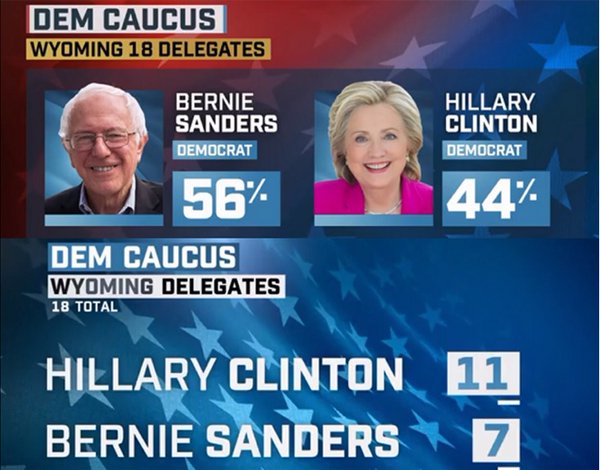 The graphic is misleading, but at first glance (and after several glances if you low-information independent voter unfamiliar with delegates, super delegates and proportional representation, which happen to be a lot a Bernie supporters), it seems unfair. How does Bernie win 56% of the vote and not win the most delegates??? Come inside for the explanation.

![Monday Open Thread [4.11.16]](https://delawareliberal.net/wp-content/uploads/2016/03/Hillary.Bernie1.jpg)
It’s tough to see Sanders win strong victories in Wisconsin and Wyoming and discover that he’s getting further away rather than closer to winning the nomination. You can argue about whether this is fair or not, but the rules haven’t been changed in the middle of the game. Candidates don’t set out to win some abstract and idealized version of the process. They set out to win a contest with defined challenges and obstacles, and their strategies should match those requirements. If there are no delegates to be netted out of Wyoming, it’s probably not worth spending any time, money or effort on it, especially if the polls show you’re going to win it easily without any effort. This contest was won or lost (depending on your perspective) in the South. Beyond that, it was won far earlier when Clinton won enough party support to dissuade others from challenging her and to get most of the party officials in her corner. The reason this was so easy to accomplish is that Clinton maintained sky-high approval ratings throughout Obama’s second term, including better than 80% support from self-described progressive Democrats. That support among progressives is what made me realize as far back as 2014 that it would be fruitless to try to take her on from the left. And that’s when I knew that she’d be the nominee. Of course, I wouldn’t call Sanders’ challenge fruitless at all if we’re talking broadly about positive influences and outcomes. But he won’t win, and I don’t think he could have won in an environment where most progressives, particularly in the South, have a very positive view of Hillary. White progressives struggle to accept these facts because Clinton is not popular in white liberal circles. But that doesn’t get you very far, as white progressive champions always fall short unless they can unite the entire progressive community and still appeal to the middle. Obama could do that. But there aren’t many Obamas out there.
![Sunday Open Thread [4.10.16]](https://delawareliberal.net/wp-content/uploads/2016/01/Blue.Open_.Thread.png)
![Saturday Open Thread [4.9.16]](https://delawareliberal.net/wp-content/uploads/2016/01/Black.White_.Open_.Thread.png)
It’s not that hard to imagine a contested convention. In fact, with Donald Trump’s path to 1,237 delegates looking tenuous, especially after his loss in Wisconsin on Tuesday night, it’s a real possibility. And it’s not hard to see how Republicans might think of Kasich or Ryan as good nominees. If Republicans were starting from scratch, both might be pretty good picks, especially from the perspective of the party “establishment” in Washington. But Republicans won’t be starting from scratch, and the “establishment” won’t pick the party’s nominee. The 2,472 delegates in Cleveland will. And most of them will be chosen at state or local party conventions a long way from Washington. Few will be household names, having quietly attended party gatherings in Fargo, North Dakota, or Cheyenne, Wyoming, for years with little remuneration or recognition. Although the proverbial Acela-riding insiders might dream of Ryan or Kasich, there are indications that the rank-and-file delegates are into Ted Cruz — and they’re the ones who will have votes in Cleveland.Repeat after Jason and me: Ted Cruz will be the Republican nominee.