Refreshing
It's good to know there's no reason to be paranoid anymore
 By
2 Comments
By
5 Comments
By
29 Comments
By
2 Comments
By
5 Comments
By
29 Comments By
27 Comments
By
27 Comments By
6 Comments
By
6 CommentsLast week, Senator Shelby from Alabama spoke out about government subsidies for manufacturing in the US. He is definitely against and thinks that subsidizing manufacturing is French.
The CEO from Compuware writes to the Senator to remind him of the subsidies his state provided for Mercedes Benz:
I am sure you were adamantly against the State of Alabama offering lucrative incentives (in essence, subsidies) to Mercedes Benz in the early 1990s to lure the German automobile manufacturer to the State.
As it turned out, Alabama offered a stunning $253 million incentive package to Mercedes. Additionally, the State also offered to train the workers, clear and improve the site, upgrade utilities, and buy 2,500 Mercedes Benz vehicles. All told, it is estimated that the incentive package totaled anywhere from $153,000 to $220,000 per created job. On top of all this, the State gave the foreign automaker a large parcel of land worth between $250 and $300 million, which was coincidentally how much the company expected to invest in building the plant.
 By
14 Comments
By
14 Comments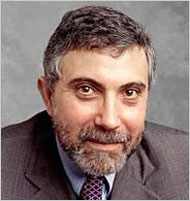
For me, reading Paul Krugman’s The Conscience of a Liberal was a reaffirmation of my liberal beliefs: equality of rights, equality of opportunity and a compression of wealth. The books is filled with over 270 pages of facts and ideas, so it would be foolhardy for me to even try to encompass them is a review. Instead, I’ll pull out some quotes from the concluding chapter. However, please take this conversation wherever you would like it to go.
One of the seeming paradoxes of America in the early twenty-first century is that those of us who call ourselves liberal are, in an important sense, conservative, while that’s that call themselves conservative are for the most part deeply radical. Liberals want to restore the middle-class society I grew up in; those who call themselves conservative want to take us back to the Gilded Age, undoing a century of history. Liberals defend longstanding institutions like Social Security and Medicare; those who call themselves conservative want to privatize or undermine those institutions. Liberals want to honor our democratic principles and the rule of law; those who call themselves conservative want the president to have dictatorial powers and have applauded the Bush administration as it imprisons people without charges and subjects them to torture.
He continues:
I believe in a relatively equal society, supported by institutions that limit extremes of wealth and poverty. I believe in democracy, civil liberties, and the rule of law. That makes me a liberal, and I’m proud of it.
On The Progressive Agenda, Krugman writes:
A progressive agenda, then would require major changes in public policy, but it would be anything but radical. Its goal would be to complete the work of the New Deal, including expansion of social insurance to cover avoidable risks that have become more important in recent decades. And as an economic matter, achieving that agenda woul be eminently doable. It would amount to giving U.S. citizens no more than the level of protection from financial risk and personal misfortune that citizens of othe radvanced countries already have.
Krugman writes On Being Partisan:
The progressive agenda is clear and achievable, but it will face fierce opposition. The central fact of modern American political life is the control of the Republican Party by movement conservatives, whose vision of what America should be is completely antithetical to that of the progressive movement. Because of that control, the notion, beloved of political pundits, that we can make progress through bipartisan consensus is simple foolish. On health care reform, which is the first domestic priority for progressives, there’s no way to achieve a bipartisan compromise between Repulbicans who want to strangle Medicare and Democrats who want guaranteed health insurance for all.
Well let’s the discussion begin.
Here are some videos of Paul Krugman talking about the economy and his book.
 By
3 Comments
By
3 Comments By
21 Comments
By
21 CommentsThis morning I went on a mission. I got a call from a friend on Saturday that there was a report of a homeless family living in a small wooded area nearby. He told me that he was going out there today to investigate and see what could be done. He joked that he would make sure his life insurance was paid up for his wife. I quickly volunteered to come along and help.
By
5 Comments