Monthly Archives: January 2010

I Feel Like I’ve Been Here Before

If you haven’t read Kevin Drum’s article, please do.  He puts into words exactly how I feel.

The striking thing to me, though, is how fast the left has turned on him. Conservatives gave Bush five or six years before they really turned on him, and even then they revolted more against the Republican establishment than against Bush himself. But the left? It took about ten months. And the depth of the revolt against Obama has been striking too. As near as I can tell, there’s a small but significant minority who are so enraged that they’d be perfectly happy to see his presidency destroyed as a kind of warning to future Democrats. It’s extraordinarily self-destructive behavior — and typically liberal, unfortunately. Just ask LBJ, Jimmy Carter, and Bill Clinton. And then ask them whether liberal revolt, in the end, strengthened liberalism or conservatism.

The speed the left has turned on him is striking.  And it’s something that has puzzled me.  I remember questioning the speed of the Tea Party rally one month after Obama was sworn in.  I remember thinking that their timing had far more to do with who was in the White House than anything else.  And I’m beginning to feel the same way about the left.

I say this because a lot of what I’m hearing, and reading, is disturbingly familiar.  I’ve heard it all before, specifically during the 2008 Democratic Presidential Primary.  The disparaging twists on Obama’s name, the predictable name calling of anyone who supports him, and the never-ending references to Kool-Aid.

It’s almost as if we came together in November 2008 under false pretenses.  It’s as if some on the left were ready and waiting for him to fail, and even eager to pounce on every failure and set back as some sort of proof.  Proof of what, I’m not sure.  What I am sure about is that the level of Obama outrage is over the top given his time in office.  I also don’t believe that this extreme approach (Obama’s a liar, he’s as bad, or worse than Bush, etc.)  moves the Overton Window as much as it makes swing voters swing in the opposite direction.  Bernard Avishai says it best:  “Hell, if his own people think he’s a sell-out and jerk, why should we support this?”

And that’s because there is simply no balance in the left’s criticism.  Obama sucks, he’s a sell-out, he’s a liar is all you read and hear from one side.  There’s never any attempt to say something like, “I hate the HCR bill, but I’m pleased with the way he’s toned down the rhetoric on terrorism, the Lily Ledbetter Act, etc. They simply can’t stand him, and I sense they’ve always felt this way – that their views aren’t driven by disappointment, as much as they are driven by the anticipation of being able to say I told you so.

And while there will be plenty of blame to go around if Coakley loses today, some of that blame will rest on the far left – a fact I’m not sure will bother them, since they seem to be okay with scalp collecting to make their point.  My problem?  I still have no idea what their point is.  Perhaps they want to kill this bill Presidency and start from scratch?

Stupid Is As Stupid Does

Banks are angry about the proposed bail-out tax. It’s so unfair! *stomps feet* They’re not just planning to hold their breaths until they turn blue and pass out, though:

Wall Street’s main lobbying arm has hired a top Supreme Court litigator to study a possible legal battle against a bank tax proposed by the Obama administration, on the theory that it would be unconstitutional, according to three industry officials briefed on the matter.

In an e-mail message sent last week to the heads of Wall Street legal departments, executives of the lobbying group, the Securities Industry and Financial Markets Association, wrote that a bank tax might be unconstitutional because it would unfairly single out and penalize big banks, according to these officials, who did not want to be identified to preserve relationships with the group’s members.

There’s a reason for the fee. The fee is to help pay for the taxpayer bailout. You know, the one that kept you solvent while the rest of us worried about losing our jobs and keeping our houses? If Wall Street Banks are worried, perhaps they need to talk to these guys:

The New York-based investment [Goldman Sachs] firm turned another eye-popping profit Thursday, earning $3.2 billion in the third quarter, as revenue from trading rose fourfold from a year ago.

As Wall Street firms typically do, Goldman set almost half that sum aside to compensate its workers. Through the first nine months of 2009, the firm socked away $16.7 billion, enough to pay the average Goldmanite $526,814.

The bonus pool is on pace to hit $21 billion for 2009, which would match the record bonus payout of 2007.

Goldman said it won’t decide the size of the bonus pool till year-end. In any case, the payments will be substantial — and will come just one year after huge sums of taxpayer dollars were funneled to financial institutions.

I’m with Paul Krugman here:

Can We Make Chutzpah A Crime?

Because if we can, we can send a bunch of bankers to jail right away

OK, this isn’t quite the classic definition of chutzpah, which is when you murder your parents, then plead for mercy because you’re an orphan. It’s more like being a drunk driver who, after killing a number of pedestrians, received life-saving treatment at a nearby hospital — and responds by suing the doctor.

I’d say it was unbelievable, but it actually should have been predictable.

Guns For Jesus

A military contractor is writing secret Biblical messages in the weapons going to soldiers.

Coded references to New Testament Bible passages about Jesus Christ are inscribed on high-powered rifle sights provided to the United States military by a Michigan company, an ABC News investigation has found.

The sights are used by U.S. troops in Iraq and Afghanistan and in the training of Iraqi and Afghan soldiers. The maker of the sights, Trijicon, has a $660 million multi-year contract to provide up to 800,000 sights to the Marine Corps, and additional contracts to provide sights to the U.S. Army.

Does Trijicon think their sly engravings will help convert the users of the rifles or is it for the Americans? Probably only Christians would be able to understand these references.

One of the citations on the gun sights, 2COR4:6, is an apparent reference to Second Corinthians 4:6 of the New Testament, which reads: “For God, who commanded the light to shine out of darkness, hath shined in our hearts, to give the light of the knowledge of the glory of God in the face of Jesus Christ.”

Other references include citations from the books of Revelation, Matthew and John dealing with Jesus as “the light of the world.” John 8:12, referred to on the gun sights as JN8:12, reads, “Whoever follows me will never walk in darkness, but will have the light of life.”

Trijicon confirmed to ABCNews.com that it adds the biblical codes to the sights sold to the U.S. military. Tom Munson, director of sales and marketing for Trijicon, which is based in Wixom, Michigan, said the inscriptions “have always been there” and said there was nothing wrong or illegal with adding them. Munson said the issue was being raised by a group that is “not Christian.” The company has said the practice began under its founder, Glyn Bindon, a devout Christian from South Africa who was killed in a 2003 plane crash.

That “not Christian” group was right though, wasn’t it? How would Tom Munson feel if his shoes had secret (non-Christian) messages written in them? He’d be angry, right?

Letters From Haiti

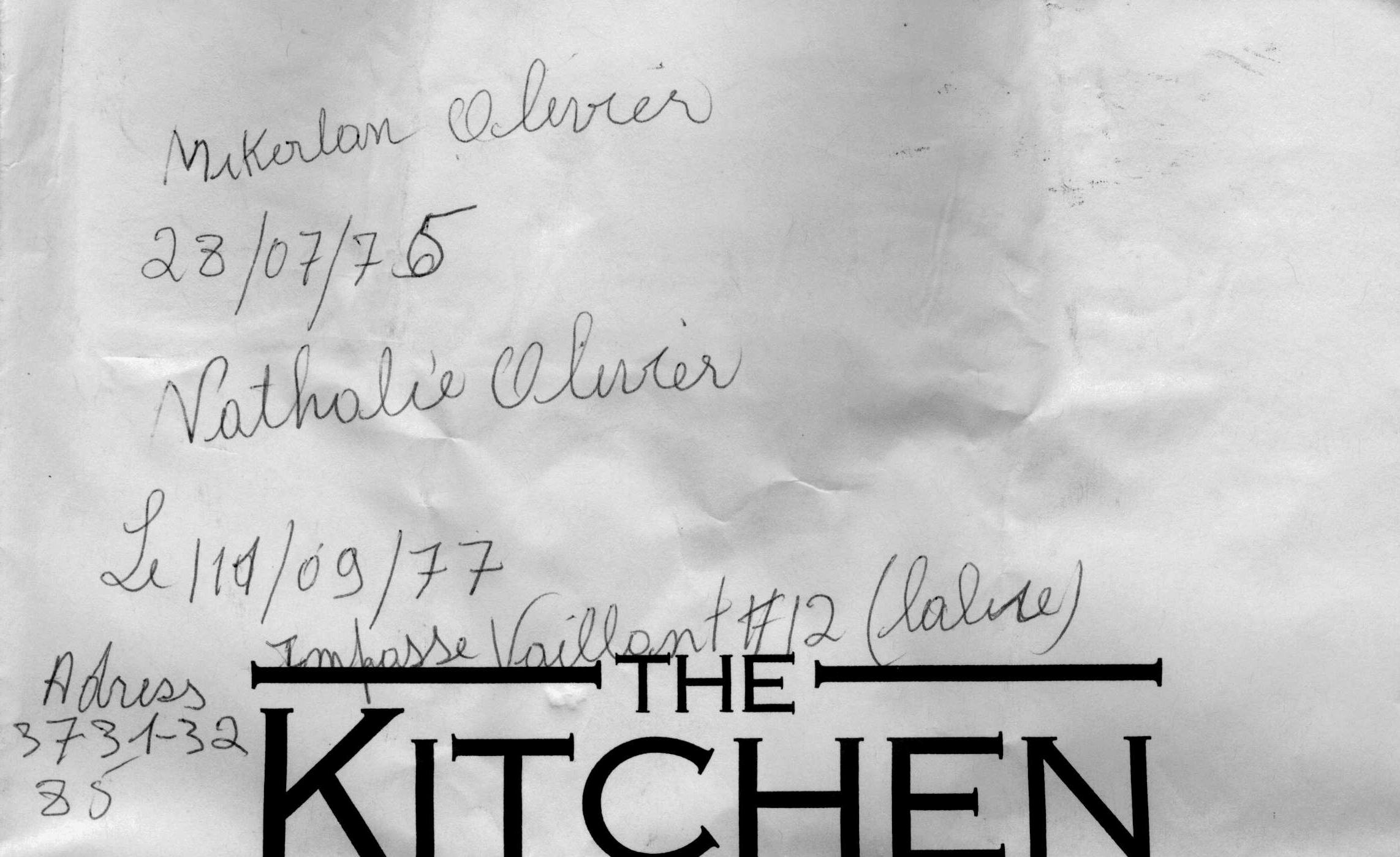
We all have a desire to help the people of Haiti in any way that we can.  Joanne Christian used an already scheduled trip to The Dominican Republic to volunteer at a 20 bed hospital in Santo Domingo that was helping 2,000 Haitian victims.  At some point, she decided that she should get some names of these people so that their family will know that they got out, although there is a likelihood that some of the people here have died of their injuries, or soon will.

Here are the images of the names that she collected on a paper bag that she had.

What can you do?  Forward these images along to Haitian friends.  Some of the letter formations in Haiti are different than here in the US, so there is some ambiguity.  Joanne was able to have a Haitian-American identify the names and is now trying to get the information to the Haitian embassy (although it is hard to get through right now).

Here are the names as best as I can transcribe them:

MiKerlan Olivier (DOB 7-28-75)
Natholie Olivier (DOB 9-11-77)
Jean Philippe Galdema
Jean Philippe Nela Pierre (mom)
Bilenie Pierre Maman
Chalaunie Viellard
Alexis Peterson (father)
Erline Emile Tonac
Rose Laure Depreville
Martine Theodore Sanon
Fanette Jean Baptiste (mom)
Franchinie Il Frard
Merville Ber Velz
Merveille Wiollgne

I Might Have To Consider Home Schooling

Especially since I’m already doing it, since my 7th grader just told me her Social Studies teacher told her that Climate Change was nonsense – which is scary, but becoming oh so predictable.  Seriously, can we just pay these people more so we can get rid of the imbeciles?  When my 7th grader questioned her about the polar ice caps and the fact that temperatures globally were rising, there was no answer other than “Look how cold it is outside.”  Simply brilliant, and how sad is it when a twelve year old totally owns a “professional” educator whose only chance of winning an argument with a child is to tell them to sit down and shut up?

Texas in charge of textbooks. I suggest you read this.

Ask Dr. Liberal: Fast Food Edition

Dr. L,

Should I eat a McDonald’s Mac Snack Wrap ™ sandwich?

Signed,
Greenwood Gourmand

Dear Greenie,

Your email has a sense of urgency to it.  I get the impression that you are in a McDonald’s holding a McDonald’s Mac Snack Wrap ™ sandwich in your hand and you are waiting for the green light.   Since Liberal Geek prints out these emails, drives them to New Haven, then conveys them to my secret office via a complex system of pneumatic tubes of the kind you can still find operating in vintage 1930’s era office buildings, and I respond in long hand depending on Liberal Geek to type them up without injecting too many typos, I hope that is not the case.
I’ll assume that your question is slightly more philosophical than practical so I’ll give you a couple of things to consider.

The first thing you have to ask your-self is, what would you eat instead of the MacDonald’s Mac Snack Wrap ™ sandwich?  If the answer is a Movie Theater box of Mike & Ikes – then eat the McDonald’s Mac Snack Wrap ™ sandwich.  If the answer is a Roasted Asparagus Salad with Goat Cheese and Bread Crumbs – then eschew the MacDonald’s Mac Snack Wrap ™ sandwich and eat the salad.On a deeper level, you need to ask what you are saying about yourself and America if you eat the McDonald’s Mac Snack Wrap ™ sandwich?   Or to quote Jack Kerouac, “Wither goest thou, America, in thy shiny car at night?”

Wither?….I’ll tell you wither.  It is clear to me that either the McDonald’s Mac Snack Wrap ™ sandwich is a part of a devious scheme to soften us up for an outright “Red Dawn” Mexican takeover of America by replacing sesame seed rolls with warm flour tortillas, OR the McDonald’s Mac Snack Wrap ™ sandwich is a social media marketing ploy devised to allow McDonalds customers in the spendy young demographics to eat while tweeting stuff like “Yo eatn McD Mac Snack Wrap…OMG! Killer!”  with their free hand.

Either way, don’t eat a McDonalds Mac Snack Wrap ™ sandwich. If you do you will be one of those sad guys who goes around pretending to be younger than he is, or someone who hates America.   Also, when is Delaware going to get an In and Out Burger? That stuff is the fucking bomb.

Health Care Reform: The Back-Up Plan

Apparently the Democrats do have a back-up plan if Coakley loses her race and nudie teabagger Scott Brown becomes the next Senator from Massachusetts:

As I noted last week, the House could simply pass the Senate bill unchanged, and Obama could sign reform into law. As recently as last week, a number of high-profile Democrats were saying that would never fly. But many are now suggesting that the House might still pull through, if House members are promised that the deal they agreed to last week will be passed separately–and quickly–through the filibuster-proof budget reconciliation process.

Jim Manley, spokesman for Senate Majority Leader Harry Reid, told the Boston Globe, the idea is “well within the scope of the rules of the Senate,” and, indeed, the deal with labor is largely a change to the tax structure of the bill, which is the sort of issue the reconciliation process is designed to address.

This could be done very fast, as soon as this Friday I’m reading.

Josh Marshall ponders the question, what will Democrats do if Coakley loses? Will they take the right lesson – that the Democratic base can’t be taken for granted and they want a better bill than the one proposed. Or will Democrats take the wrong lesson – that Americans hate health care reform. The media is already primed for the latter and not the former.

As a matter of politics, I have little doubt that even for Dems in marginal districts, it’s actually the safer call for them to vote for the bill a second time. Because the key is they already voted for it once. And from a strategic position in their districts, that is all that counts. Saying, ‘yes, I voted for it but, hey, when it came back from conference I refused to vote for it again and it never came to a vote and the legislation died!’ just ain’t a distinction anyone’s Republican opponents are going to allow.

I suspect it won’t even cut it for those who actually voted no the first time. But it definitely won’t work for those who already voted for it once. That’s the lesson of 1994, the conservative and moderate Democrats who killed health care reform derived not an ounce of benefit for having done so. Indeed, they were slaughtered en masse.

I have very little doubt that that analysis is correct. But that doesn’t mean the members in question will see it that way.

Monday Open Thread

It’s Monday and at least some of you get to enjoy a 3-day weekend. The rest of us have to work. So let’s open this thread.

The danger of Facebook:

Anyone who is tempted to rekindle old romances or start new ones on the internet be warned: Facebook is now being cited in almost 20 per cent of divorces.

A law firm in America has made the startling claim after discovering that nearly one in five of its clients named the social networking site in their petitions.

Divorce-Online’s managing director Mark Keenan said he was “really surprised” to discover that out of 5,436 cases, 989 contained a reference to Facebook. “The most common reason seemed to be people having inappropriate sexual chats with people they were not supposed to,” he said.

Ah, the digital age! Facebook is only the tool for cheating spouses, not the actual cause.

It’s about time we started discussing this topic:

Vice President Joe Biden said at a Florida fundraiser Sunday that the 60-seat threshold for passing legislation in the Senate put a dangerous new roadblock in the way of American government.

“As long as I have served … I’ve never seen, as my uncle once said, the constitution stood on its head as they’ve done. This is the first time every single solitary decisions has required 60 senators,” Biden said. “No democracy has survived needing a supermajority.”

Despite that dire warning, Biden said he’s “optimistic” the country will appreciate the administration’s accomplishments: “The American people are very smart, and we’ll demonstrate by November that the project is working.”

I think there needs to be a change because the U.S. will become almost ungovernable if the status quo continues and Scott Brown becomes a Senator. We need to find a way to balance the needs of the minority party with the need of the majority to function. The current rules are being abused and they need to change. I just wish the administration had been making this argument for long and not just now when it looks like they’re about to lose their 60-seat majority.

President Obama On Martin Luther King, Jr.

Yesterday President Obama gave a very moving speech on the legacy of Martin Luther King, Jr.

Transcript

THE PRESIDENT: Good morning. Praise be to God. Let me begin by thanking the entire Vermont Avenue Baptist Church family for welcoming our family here today. It feels like a family. Thank you for making us feel that way. (Applause.) To Pastor Wheeler, first lady Wheeler, thank you so much for welcoming us here today. Congratulations on Jordan Denice — aka Cornelia. (Laughter.)

Michelle and I have been blessed with a new nephew this year as well — Austin Lucas Robinson. (Applause.) So maybe at the appropriate time we can make introductions. (Laughter.) Now, if Jordan’s father is like me, then that will be in about 30 years. (Laughter.) That is a great blessing.

Michelle and Malia and Sasha and I are thrilled to be here today. And I know that sometimes you have to go through a little fuss to have me as a guest speaker. (Laughter.) So let me apologize in advance for all the fuss.

We gather here, on a Sabbath, during a time of profound difficulty for our nation and for our world. In such a time, it soothes the soul to seek out the Divine in a spirit of prayer; to seek solace among a community of believers. But we are not here just to ask the Lord for His blessing. We aren’t here just to interpret His Scripture. We’re also here to call on the memory of one of His noble servants, the Reverend Dr. Martin Luther King, Jr.

Now, it’s fitting that we do so here, within the four walls of Vermont Avenue Baptist Church — here, in a church that rose like the phoenix from the ashes of the civil war; here in a church formed by freed slaves, whose founding pastor had worn the union blue; here in a church from whose pews congregants set out for marches and from whom choir anthems of freedom were heard; from whose sanctuary King himself would sermonize from time to time.

One of those times was Thursday, December 6, 1956. Pastor, you said you were a little older than me, so were you around at that point? (Laughter.) You were three years old — okay. (Laughter.) I wasn’t born yet. (Laughter.)

On Thursday, December 6, 1956. And before Dr. King had pointed us to the mountaintop, before he told us about his dream in front of the Lincoln Memorial, King came here, as a 27-year-old preacher, to speak on what he called “The Challenge of a New Age.” “The Challenge of a New Age.” It was a period of triumph, but also uncertainty, for Dr. King and his followers — because just weeks earlier, the Supreme Court had ordered the desegregation of Montgomery’s buses, a hard-wrought, hard-fought victory that would put an end to the 381-day historic boycott down in Montgomery, Alabama.

And yet, as Dr. King rose to take that pulpit, the future still seemed daunting. It wasn’t clear what would come next for the movement that Dr. King led. It wasn’t clear how we were going to reach the Promised Land. Because segregation was still rife; lynchings still a fact. Yes, the Supreme Court had ruled not only on the Montgomery buses, but also on Brown v. Board of Education. And yet that ruling was defied throughout the South — by schools and by states; they ignored it with impunity. And here in the nation’s capital, the federal government had yet to fully align itself with the laws on its books and the ideals of its founding.

So it’s not hard for us, then, to imagine that moment. We can imagine folks coming to this church, happy about the boycott being over. We can also imagine them, though, coming here concerned about their future, sometimes second-guessing strategy, maybe fighting off some creeping doubts, perhaps despairing about whether the movement in which they had placed so many of their hopes — a movement in which they believed so deeply — could actually deliver on its promise.

So here we are, more than half a century later, once again facing the challenges of a new age. Here we are, once more marching toward an unknown future, what I call the Joshua generation to their Moses generation — the great inheritors of progress paid for with sweat and blood, and sometimes life itself.

We’ve inherited the progress of unjust laws that are now overturned. We take for granted the progress of a ballot being available to anybody who wants to take the time to actually vote. We enjoy the fruits of prejudice and bigotry being lifted — slowly, sometimes in fits and starts, but irrevocably — from human hearts. It’s that progress that made it possible for me to be here today; for the good people of this country to elect an African American the 44th President of the United States of America.

Reverend Wheeler mentioned the inauguration, last year’s election. You know, on the heels of that victory over a year ago, there were some who suggested that somehow we had entered into a post-racial America, all those problems would be solved. There were those who argued that because I had spoke of a need for unity in this country that our nation was somehow entering into a period of post-partisanship. That didn’t work out so well. There was a hope shared by many that life would be better from the moment that I swore that oath.

Of course, as we meet here today, one year later, we know the promise of that moment has not yet been fully fulfilled. Because of an era of greed and irresponsibility that sowed the seeds of its own demise, because of persistent economic troubles unaddressed through the generations, because of a banking crisis that brought the financial system to the brink of catastrophe, we are being tested — in our own lives and as a nation — as few have been tested before.

Unemployment is at its highest level in more than a quarter of a century. Nowhere is it higher than the African American community. Poverty is on the rise. Home ownership is slipping. Beyond our shores, our sons and daughters are fighting two wars. Closer to home, our Haitian brothers and sisters are in desperate need. Bruised, battered, many people are legitimately feeling doubt, even despair, about the future. Like those who came to this church on that Thursday in 1956, folks are wondering, where do we go from here?

I understand those feelings. I understand the frustration and sometimes anger that so many folks feel as they struggle to stay afloat. I get letters from folks around the country every day; I read 10 a night out of the 40,000 that we receive. And there are stories of hardship and desperation, in some cases, pleading for help: I need a job. I’m about to lose my home. I don’t have health care — it’s about to cause my family to be bankrupt. Sometimes you get letters from children: My mama or my daddy have lost their jobs, is there something you can do to help? Ten letters like that a day we read.

So, yes, we’re passing through a hard winter. It’s the hardest in some time. But let’s always remember that, as a people, the American people, we’ve weathered some hard winters before. This country was founded during some harsh winters. The fishermen, the laborers, the craftsmen who made camp at Valley Forge — they weathered a hard winter. The slaves and the freedmen who rode an underground railroad, seeking the light of justice under the cover of night — they weathered a hard winter. The seamstress whose feet were tired, the pastor whose voice echoes through the ages — they weathered some hard winters. It was for them, as it is for us, difficult, in the dead of winter, to sometimes see spring coming. They, too, sometimes felt their hopes deflate. And yet, each season, the frost melts, the cold recedes, the sun reappears. So it was for earlier generations and so it will be for us.

What we need to do is to just ask what lessons we can learn from those earlier generations about how they sustained themselves during those hard winters, how they persevered and prevailed. Let us in this Joshua generation learn how that Moses generation overcame.

Let me offer a few thoughts on this. First and foremost, they did so by remaining firm in their resolve. Despite being threatened by sniper fire or planted bombs, by shoving and punching and spitting and angry stares, they adhered to that sweet spirit of resistance, the principles of nonviolence that had accounted for their success.

Second, they understood that as much as our government and our political parties had betrayed them in the past — as much as our nation itself had betrayed its own ideals — government, if aligned with the interests of its people, can be — and must be — a force for good. So they stayed on the Justice Department. They went into the courts. They pressured Congress, they pressured their President. They didn’t give up on this country. They didn’t give up on government. They didn’t somehow say government was the problem; they said, we’re going to change government, we’re going to make it better. Imperfect as it was, they continued to believe in the promise of democracy; in America’s constant ability to remake itself, to perfect this union.

Third, our predecessors were never so consumed with theoretical debates that they couldn’t see progress when it came. Sometimes I get a little frustrated when folks just don’t want to see that even if we don’t get everything, we’re getting something. (Applause.) King understood that the desegregation of the Armed Forces didn’t end the civil rights movement, because black and white soldiers still couldn’t sit together at the same lunch counter when they came home. But he still insisted on the rightness of desegregating the Armed Forces. That was a good first step — even as he called for more. He didn’t suggest that somehow by the signing of the Civil Rights that somehow all discrimination would end. But he also didn’t think that we shouldn’t sign the Civil Rights Act because it hasn’t solved every problem. Let’s take a victory, he said, and then keep on marching. Forward steps, large and small, were recognized for what they were — which was progress.

Fourth, at the core of King’s success was an appeal to conscience that touched hearts and opened minds, a commitment to universal ideals — of freedom, of justice, of equality — that spoke to all people, not just some people. For King understood that without broad support, any movement for civil rights could not be sustained. That’s why he marched with the white auto worker in Detroit. That’s why he linked arm with the Mexican farm worker in California, and united people of all colors in the noble quest for freedom.

Of course, King overcame in other ways as well. He remained strategically focused on gaining ground — his eyes on the prize constantly — understanding that change would not be easy, understand that change wouldn’t come overnight, understanding that there would be setbacks and false starts along the way, but understanding, as he said in 1956, that “we can walk and never get weary, because we know there is a great camp meeting in the promised land of freedom and justice.”

And it’s because the Moses generation overcame that the trials we face today are very different from the ones that tested us in previous generations. Even after the worst recession in generations, life in America is not even close to being as brutal as it was back then for so many. That’s the legacy of Dr. King and his movement. That’s our inheritance. Having said that, let there be no doubt the challenges of our new age are serious in their own right, and we must face them as squarely as they faced the challenges they saw.

I know it’s been a hard road we’ve traveled this year to rescue the economy, but the economy is growing again. The job losses have finally slowed, and around the country, there’s signs that businesses and families are beginning to rebound. We are making progress.

I know it’s been a hard road that we’ve traveled to reach this point on health reform. I promise you I know. (Laughter.) But under the legislation I will sign into law, insurance companies won’t be able to drop you when you get sick, and more than 30 million people — (applause) — our fellow Americans will finally have insurance. More than 30 million men and women and children, mothers and fathers, won’t be worried about what might happen to them if they get sick. This will be a victory not for Democrats; this will be a victory for dignity and decency, for our common humanity. This will be a victory for the United States of America.

Let’s work to change the political system, as imperfect as it is. I know people can feel down about the way things are going sometimes here in Washington. I know it’s tempting to give up on the political process. But we’ve put in place tougher rules on lobbying and ethics and transparency — tougher rules than any administration in history. It’s not enough, but it’s progress. Progress is possible. Don’t give up on voting. Don’t give up on advocacy. Don’t give up on activism. There are too many needs to be met, too much work to be done. Like Dr. King said, “We must accept finite disappointment but never lose infinite hope.”

Let us broaden our coalition, building a confederation not of liberals or conservatives, not of red states or blue states, but of all Americans who are hurting today, and searching for a better tomorrow. The urgency of the hour demands that we make common cause with all of America’s workers — white, black, brown — all of whom are being hammered by this recession, all of whom are yearning for that spring to come. It demands that we reach out to those who’ve been left out in the cold even when the economy is good, even when we’re not in recession — the youth in the inner cities, the youth here in Washington, D.C., people in rural communities who haven’t seen prosperity reach them for a very long time. It demands that we fight discrimination, whatever form it may come. That means we fight discrimination against gays and lesbians, and we make common cause to reform our immigration system.

And finally, we have to recognize, as Dr. King did, that progress can’t just come from without — it also has to come from within. And over the past year, for example, we’ve made meaningful improvements in the field of education. I’ve got a terrific Secretary of Education, Arne Duncan. He’s been working hard with states and working hard with the D.C. school district, and we’ve insisted on reform, and we’ve insisted on accountability. We we’re putting in more money and we’ve provided more Pell Grants and more tuition tax credits and simpler financial aid forms. We’ve done all that, but parents still need to parent. (Applause.) Kids still need to own up to their responsibilities. We still have to set high expectations for our young people. Folks can’t simply look to government for all the answers without also looking inside themselves, inside their own homes, for some of the answers.

Progress will only come if we’re willing to promote that ethic of hard work, a sense of responsibility, in our own lives. I’m not talking, by the way, just to the African American community. Sometimes when I say these things people assme, well, he’s just talking to black people about working hard. No, no, no, no. I’m talking to the American community. Because somewhere along the way, we, as a nation, began to lose touch with some of our core values. You know what I’m talking about. We became enraptured with the false prophets who prophesized an easy path to success, paved with credit cards and home equity loans and get-rich-quick schemes, and the most important thing was to be a celebrity; it doesn’t matter what you do, as long as you get on TV. That’s everybody.

We forgot what made the bus boycott a success; what made the civil rights movement a success; what made the United States of America a success — that, in this country, there’s no substitute for hard work, no substitute for a job well done, no substitute for being responsible stewards of God’s blessings.

What we’re called to do, then, is rebuild America from its foundation on up. To reinvest in the essentials that we’ve neglected for too long — like health care, like education, like a better energy policy, like basic infrastructure, like scientific research. Our generation is called to buckle down and get back to basics.

We must do so not only for ourselves, but also for our children, and their children. For Jordan and for Austin. That’s a sacrifice that falls on us to make. It’s a much smaller sacrifice than the Moses generation had to make, but it’s still a sacrifice.

Yes, it’s hard to transition to a clean energy economy. Sometimes it may be inconvenient, but it’s a sacrifice that we have to make. It’s hard to be fiscally responsible when we have all these human needs, and we’re inheriting enormous deficits and debt, but that’s a sacrifice that we’re going to have to make. You know, it’s easy, after a hard day’s work, to just put your kid in front of the TV set — you’re tired, don’t want to fuss with them — instead of reading to them, but that’s a sacrifice we must joyfully accept.

Sometimes it’s hard to be a good father and good mother. Sometimes it’s hard to be a good neighbor, or a good citizen, to give up time in service of others, to give something of ourselves to a cause that’s greater than ourselves — as Michelle and I are urging folks to do tomorrow to honor and celebrate Dr. King. But these are sacrifices that we are called to make. These are sacrifices that our faith calls us to make. Our faith in the future. Our faith in America. Our faith in God.

And on his sermon all those years ago, Dr. King quoted a poet’s verse:

Truth forever on the scaffold
Wrong forever on the throne…
And behind the dim unknown stands God
Within the shadows keeping watch above his own.

Even as Dr. King stood in this church, a victory in the past and uncertainty in the future, he trusted God. He trusted that God would make a way. A way for prayers to be answered. A way for our union to be perfected. A way for the arc of the moral universe, no matter how long, to slowly bend towards truth and bend towards freedom, to bend towards justice. He had faith that God would make a way out of no way.

You know, folks ask me sometimes why I look so calm. (Laughter.) They say, all this stuff coming at you, how come you just seem calm? And I have a confession to make here. There are times where I’m not so calm. (Laughter.) Reggie Love knows. My wife knows. There are times when progress seems too slow. There are times when the words that are spoken about me hurt. There are times when the barbs sting. There are times when it feels like all these efforts are for naught, and change is so painfully slow in coming, and I have to confront my own doubts.

But let me tell you — during those times it’s faith that keeps me calm. (Applause.) It’s faith that gives me peace. The same faith that leads a single mother to work two jobs to put a roof over her head when she has doubts. The same faith that keeps an unemployed father to keep on submitting job applications even after he’s been rejected a hundred times. The same faith that says to a teacher even if the first nine children she’s teaching she can’t reach, that that 10th one she’s going to be able to reach. The same faith that breaks the silence of an earthquake’s wake with the sound of prayers and hymns sung by a Haitian community. A faith in things not seen, in better days ahead, in Him who holds the future in the hollow of His hand. A faith that lets us mount up on wings like eagles; lets us run and not be weary; lets us walk and not faint.

So let us hold fast to that faith, as Joshua held fast to the faith of his fathers, and together, we shall overcome the challenges of a new age. (Applause.) Together, we shall seize the promise of this moment. Together, we shall make a way through winter, and we’re going to welcome the spring. Through God all things are possible. (Applause.)

May the memory of Dr. Martin Luther King continue to inspire us and ennoble our world and all who inhabit it. And may God bless the United States of America. Thank you very much, everybody. God bless you. (Applause.)

Today We Celebrate The Life of Martin Luther King, Jr.

Today we celebrate the life of Martin Luther King, Jr. He was a man who had a vision and the gifts to make everyone else not only see the vision as he saw it but to believe that it was possible. Although Dr. King was taken from us much too young, his beautiful words resonate through the ages and still inspire people who never got to see him in person.

I’ll have to admit that my favorite speech of all time is his “I Have A Dream Speech,” delivered on August 28, 1963 in Washington, D.C. King was only 34 years old when he delivered this speech.

Text of “I Have A Dream”

am happy to join with you today in what will go down in history as the greatest demonstration for freedom in the history of our nation. [Applause]
Five score years ago, a great American, in whose symbolic shadow we stand signed the Emancipation Proclamation. This momentous decree came as a great beacon light of hope to millions of Negro slaves who had been seared in the flames of withering injustice. It came as a joyous daybreak to end the long night of captivity.

But one hundred years later, we must face the tragic fact that the Negro is still not free. One hundred years later, the life of the Negro is still sadly crippled by the manacles of segregation and the chains of discrimination. One hundred years later, the Negro lives on a lonely island of poverty in the midst of a vast ocean of material prosperity. One hundred years later, the Negro is still languishing in the corners of American society and finds himself an exile in his own land. So we have come here today to dramatize an appalling condition.

In a sense we have come to our nation’s capital to cash a check. When the architects of our republic wrote the magnificent words of the Constitution and the declaration of Independence, they were signing a promissory note to which every American was to fall heir. This note was a promise that all men would be guaranteed the inalienable rights of life, liberty, and the pursuit of happiness.

It is obvious today that America has defaulted on this promissory note insofar as her citizens of color are concerned. Instead of honoring this sacred obligation, America has given the Negro people a bad check which has come back marked “insufficient funds.” But we refuse to believe that the bank of justice is bankrupt. We refuse to believe that there are insufficient funds in the great vaults of opportunity of this nation. So we have come to cash this check — a check that will give us upon demand the riches of freedom and the security of justice. We have also come to this hallowed spot to remind America of the fierce urgency of now. This is no time to engage in the luxury of cooling off or to take the tranquilizing drug of gradualism. Now is the time to rise from the dark and desolate valley of segregation to the sunlit path of racial justice. Now is the time to open the doors of opportunity to all of God’s children. Now is the time to lift our nation from the quicksands of racial injustice to the solid rock of brotherhood.

It would be fatal for the nation to overlook the urgency of the moment and to underestimate the determination of the Negro. This sweltering summer of the Negro’s legitimate discontent will not pass until there is an invigorating autumn of freedom and equality. Nineteen sixty-three is not an end, but a beginning. Those who hope that the Negro needed to blow off steam and will now be content will have a rude awakening if the nation returns to business as usual. There will be neither rest nor tranquility in America until the Negro is granted his citizenship rights. The whirlwinds of revolt will continue to shake the foundations of our nation until the bright day of justice emerges.

But there is something that I must say to my people who stand on the warm threshold which leads into the palace of justice. In the process of gaining our rightful place we must not be guilty of wrongful deeds. Let us not seek to satisfy our thirst for freedom by drinking from the cup of bitterness and hatred.

We must forever conduct our struggle on the high plane of dignity and discipline. We must not allow our creative protest to degenerate into physical violence. Again and again we must rise to the majestic heights of meeting physical force with soul force. The marvelous new militancy which has engulfed the Negro community must not lead us to distrust of all white people, for many of our white brothers, as evidenced by their presence here today, have come to realize that their destiny is tied up with our destiny and their freedom is inextricably bound to our freedom. We cannot walk alone.

And as we walk, we must make the pledge that we shall march ahead. We cannot turn back. There are those who are asking the devotees of civil rights, “When will you be satisfied?” We can never be satisfied as long as our bodies, heavy with the fatigue of travel, cannot gain lodging in the motels of the highways and the hotels of the cities. We cannot be satisfied as long as the Negro’s basic mobility is from a smaller ghetto to a larger one. We can never be satisfied as long as a Negro in Mississippi cannot vote and a Negro in New York believes he has nothing for which to vote. No, no, we are not satisfied, and we will not be satisfied until justice rolls down like waters and righteousness like a mighty stream.

I am not unmindful that some of you have come here out of great trials and tribulations. Some of you have come fresh from narrow cells. Some of you have come from areas where your quest for freedom left you battered by the storms of persecution and staggered by the winds of police brutality. You have been the veterans of creative suffering. Continue to work with the faith that unearned suffering is redemptive.

Go back to Mississippi, go back to Alabama, go back to Georgia, go back to Louisiana, go back to the slums and ghettos of our northern cities, knowing that somehow this situation can and will be changed. Let us not wallow in the valley of despair.

I say to you today, my friends, that in spite of the difficulties and frustrations of the moment, I still have a dream. It is a dream deeply rooted in the American dream.

I have a dream that one day this nation will rise up and live out the true meaning of its creed: “We hold these truths to be self-evident: that all men are created equal.”

I have a dream that one day on the red hills of Georgia the sons of former slaves and the sons of former slave owners will be able to sit down together at a table of brotherhood.

I have a dream that one day even the state of Mississippi, a desert state, sweltering with the heat of injustice and oppression, will be transformed into an oasis of freedom and justice.

I have a dream that my four children will one day live in a nation where they will not be judged by the color of their skin but by the content of their character.

I have a dream today.

I have a dream that one day the state of Alabama, whose governor’s lips are presently dripping with the words of interposition and nullification, will be transformed into a situation where little black boys and black girls will be able to join hands with little white boys and white girls and walk together as sisters and brothers.

I have a dream today.

I have a dream that one day every valley shall be exalted, every hill and mountain shall be made low, the rough places will be made plain, and the crooked places will be made straight, and the glory of the Lord shall be revealed, and all flesh shall see it together.

This is our hope. This is the faith with which I return to the South. With this faith we will be able to hew out of the mountain of despair a stone of hope. With this faith we will be able to transform the jangling discords of our nation into a beautiful symphony of brotherhood. With this faith we will be able to work together, to pray together, to struggle together, to go to jail together, to stand up for freedom together, knowing that we will be free one day.

This will be the day when all of God’s children will be able to sing with a new meaning, “My country, ’tis of thee, sweet land of liberty, of thee I sing. Land where my fathers died, land of the pilgrim’s pride, from every mountainside, let freedom ring.”

And if America is to be a great nation this must become true. So let freedom ring from the prodigious hilltops of New Hampshire. Let freedom ring from the mighty mountains of New York. Let freedom ring from the heightening Alleghenies of Pennsylvania!

Let freedom ring from the snowcapped Rockies of Colorado!

Let freedom ring from the curvaceous peaks of California!

But not only that; let freedom ring from Stone Mountain of Georgia!

Let freedom ring from Lookout Mountain of Tennessee!

Let freedom ring from every hill and every molehill of Mississippi. From every mountainside, let freedom ring.

When we let freedom ring, when we let it ring from every village and every hamlet, from every state and every city, we will be able to speed up that day when all of God’s children, black men and white men, Jews and Gentiles, Protestants and Catholics, will be able to join hands and sing in the words of the old Negro spiritual, “Free at last! free at last! thank God Almighty, we are free at last!”

Tea Parties Organize To Take Control

The one thing you have to give the Right credit is their ability to play the long game.  They are quite happy to chip away at policy they don’t like and seem to understand that baby steps are still, indeed, steps.

Steve Benen lays it out, and we need to pay attention.

The Tea Party movement ignited a year ago, fueled by anti-establishment anger. Now, Tea Party activists are trying to take over the establishment, ground up.

Across the country, they are signing up to be Republican precinct leaders, a position so low-level that it often remains vacant, but which comes with the ability to vote for the party executives who endorse candidates, approve platforms and decide where the party spends money.

Calls to mind when Conservatives mobilized the take-over of School Boards – another low-level position whose impact wasn’t realized immediately.  And isn’t that going well?

There’s nothing wrong with passionate citizens getting involved in the political process. But the American mainstream may not appreciate the fact that uninformed crazies — who think death panels are real, but global warming isn’t — intend to take over the Republican infrastructure, more than they already have…

…But that’s what makes 2010 dangerous — the mainstream doesn’t realize the radical nature of the Tea Party “movement”; Democratic voters feel underwhelmed by the pace of progress; and the electorate may very well reward radicalization.

The consequences of the rise of nihilists are hard to predict, but the possibilities are chilling.

Now, I’m not sure what can be done to stop this infestation, and that really is a Republican problem.  What I can do is not take my eye off the ball.  These people truly frighten me, and the idea of them in charge of anything that impacts my life is unacceptable.  And that’s the choice that’s forming, and will continue to form as Tea Party members leave the fringe and infiltrate the mainstream.  So while there are bad Democrats, who we should deal with, it doesn’t make sense to jettison them without a viable alternative to take their place.  And the fact is… replacing bad Dems with Tea Partiers is not an acceptable choice.

And if we go down this path we could find ourselves living in a “Christian” nation and all that that entails.